
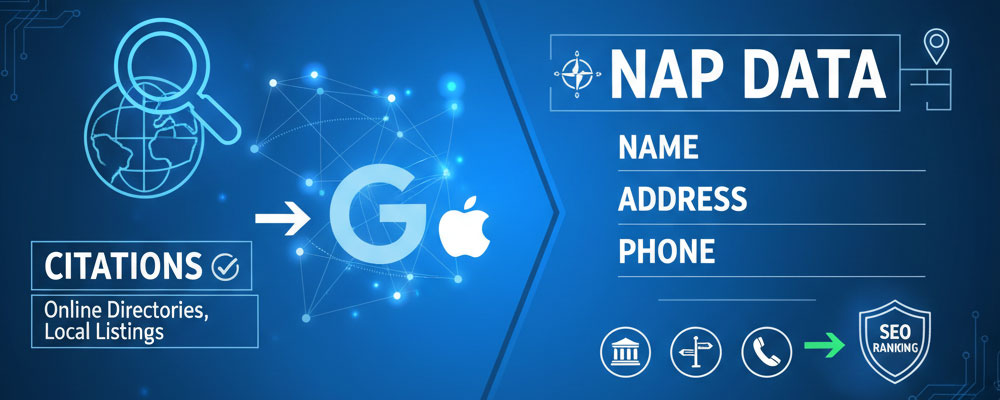
Citations and NAP in the Age of AI Search
Posted on SEO | Zero-Click Search | AI Search | Local SEO | NAP | Citations

- Consistent NAP (Name, Address, Phone) data across all platforms is now your business’s identity proof for AI-driven search engines.
- Citations aren’t about backlinks anymore—they’re verification signals that tell Google and AI assistants your business is real and trustworthy.
- In the era of AI Mode and zero-click searches, businesses with clean, uniform data footprints are the ones that actually get mentioned in generative results.
Estimated reading time: 10 minutes
Why Consistency Is Your New SEO Lifeline
The landscape of local SEO is changing rapidly. For years, businesses focused on rankings with backlinks, keywords, and citations—treating each directory as just a checkbox on a long list of optimizations. But now that AI-driven search experiences are dominating Google’s results pages, the game has completely transformed.
We’ve entered a phase where AI systems like Google’s Search Generative Experience (SGE), Bing Copilot, and even ChatGPT are redefining what it means to “show up” online. Instead of providing ten blue links, these systems synthesize answers by pulling structured data from numerous sources to generate summaries, lists, and recommendations.
That’s where citations and NAP (Name, Address, Phone) consistency suddenly become the foundation of your digital visibility.
Because now, it’s not about who has the most citations — it’s about who can be trusted the most by machines.
The New Rules of Online Visibility
Traditional SEO relied heavily on content optimization and link authority. You could improve your rankings by creating high-quality pages and obtaining backlinks from trusted sites. Citations also helped, mainly because they served as mini-backlinks on reputable directories.
AI search doesn’t work that way.
Instead of crawling the web to find the top ten pages for a keyword, AI models gather verified information about businesses, products, and services, then provide summarized answers—often without directing users anywhere.
When a user types “best Italian restaurant near me that’s open late,” the AI isn’t browsing your site. It’s analyzing structured data from platforms like Google Business Profile, Yelp, Bing Places, Apple Maps, TripAdvisor, and others to generate an instant recommendation.
If your business info across those sources is inconsistent—different phone numbers, slightly different addresses, old URLs—the system hesitates. And hesitation in AI land means exclusion.
That’s why NAP consistency is no longer just a local SEO task; it’s your business’s proof of presence in an ecosystem that’s becoming more algorithm-driven.
Why NAP Is Your Digital Fingerprint
Think of your NAP as your business’s DNA. It’s how Google, Bing, and every AI engine identify you across the web.
The problem is, most small businesses underestimate how fragmented their NAP data becomes over time. They move locations, change phone numbers, rebrand domains—and suddenly there are half a dozen variations floating around the web.
That inconsistency creates uncertainty.
When Google can’t reliably match all those variations to a single entity, your authority score weakens. And since AI search relies heavily on entity confidence rather than keyword match, you can suddenly disappear from local visibility.
In the simplest terms:
- Consistent NAP = Verified Entity = Trustworthy Source.
- Inconsistent NAP = Confusion = Omission from AI responses.
This is why even small details matter—using “Suite” instead of “#,” including “LLC” in some listings but not others, or keeping an old 631 number active on a forgotten directory. These tiny mistakes can create major confusion in an AI-driven search world.
Citations as Evidence, Not Links
In the pre-AI SEO era, citations were a ranking factor because they provided Google with more places to crawl and verify your business’s existence—bonus points if they included a link. Today, their purpose is entirely different.
Citations are now evidence.
They behave like multiple affidavits verifying your business details across the web. When enough of these records match—same NAP, same categories, same attributes—Google’s Knowledge Graph (the large database of entities and relationships that powers AI answers) assigns you a higher confidence score.
That confidence decides whether you’re mentioned in an AI summary, featured in a “top three” carousel, or overlooked entirely.
So, it’s not about how many citations you have; it’s about how accurate and uniform they are.
If Yelp says you’re open until 10, Facebook says 9:30, and your website says 11, the AI doesn’t know which is true—and it’s not about to risk giving the wrong answer. It’ll choose someone else.
Structured Data: The Bridge Between Citations and AI
Google’s AI doesn’t interpret your website the way a person does—it analyzes schema markup, JSON-LD, and structured data. When this structured data matches your NAP and citation information across other platforms, it forms a strong feedback loop of validation.
If that matches what appears on your Google Business Profile, Yelp, and Bing Places listings, Google considers your data verified. This consistency directly affects whether your business appears in generative results.
If there’s even a slight variation, the AI begins questioning whether it’s observing the same entity—and once doubt arises, visibility decreases.
In short, schema markup and citation alignment are the new link building methods. They demonstrate to machines that you are a reliable, legitimate source.
Why AI Search Relies on These Signals
AI assistants—Google’s, OpenAI’s, Apple’s—all pull from structured data ecosystems to avoid providing incorrect answers.
They lack the luxury of saying, “Maybe.”
So, when a user asks, “What’s the best pediatric dentist near me?” the AI relies on verified information: Google reviews, category tags, business attributes (like “accepts children,” “emergency appointments”), and citation-verified contact details.
That’s why many local businesses will soon find their visibility declining—not because of content quality but due to data integrity.
The future of local SEO isn’t about convincing Google that you’re relevant; it’s about demonstrating you’re real.
The Rise of Zero-Click Search and AI Summaries
Zero-click searches—where users never leave the search results—now make up more than half of all Google queries. With SGE rolling out, that percentage will increase significantly.
When AI snapshots summarize results, they often cite three or four businesses as sources. You want to be one of them.
But the only way to be visible in that generative layer is to have a strong data foundation—accurate citations, consistent NAP, structured content, and an active Google Business Profile.
Your website still matters (and will always matter for depth, conversions, and brand storytelling), but AI doesn’t care about pretty design—it cares about precision.
The businesses with the cleanest data footprints will win.
How to Audit and Fix Inconsistent Citations
Many businesses think they’re doing fine—until they conduct an audit and find their NAP is messy. Here’s how to fix it.
Step 1: Gather a master NAP record.
Create a single, authoritative version of your business info:
- Exact business name (as it should appear everywhere)
- Full street address (avoid abbreviations)
- Primary phone number (no alternates)
- Main website URL (not a redirect or subdomain)
- Business hours and category
Keep that as your “source of truth.”
Step 2: Audit your citations.
Run a scan using BrightLocal, Moz Local, or Whitespark to find mismatched or duplicate listings. You’ll likely find:
- Old locations still indexed
- Variations in name formatting (with/without LLC)
- Incorrect hours or missing links
Step 3: Prioritize fixing the top-tier listings first.
Start with the “Big 4” data sources that supply hundreds of directories downstream.
- Google Business Profile
- Yelp
- Bing Places
- Apple Maps
Then move to secondary aggregators like Data Axle, Neustar/Localeze, and Foursquare.
Step 4: Eliminate duplicates.
Duplicate listings confuse Google. Merge or delete them to clean up your digital footprint.
Step 5: Standardize future updates.
Every time your business info changes—new number, expanded hours—update your master record and push the changes out everywhere. Treat it like accounting.
Step 6: Use schema to reinforce your citations.
Update your site’s LocalBusiness schema to match your NAP perfectly. Add sameAs links to major directories to tie them all together. Example:
“sameAs”: [
“https://www.facebook.com/visionarygraphics”,
“https://www.yelp.com/biz/visionary-graphics-marketing-riverhead”,
“https://www.linkedin.com/company/visionary-graphics”
]
This cross-references your business identity and boosts your entity score.
Don’t Forget the Human Layer
All this talk about machine trust might seem clinical, but it has real-world benefits. Consistency also builds consumer trust.
When someone searches for your business and sees the same name, phone number, and hours across different platforms, it strengthens trust. This is even more effective when reviews and photos also match.
AI systems are trained on human behavior. If customers treat your business as credible, the AI mirrors that trust.
So, yes, your data consistency helps Google—but it also helps people feel safe choosing you.
The Future of Local Search Optimization
Within the next year or two, we’ll see Google’s AI Mode and similar systems evolve into personalized recommendation engines that remember preferences, locations, and behavioral cues.
Your NAP and citations will serve as the foundation for your business’s identity layer, enabling those engines to present your business as an option. Without it, you’ll never even make it into the conversation.
Imagine someone saying to their phone:
“Find a local estate attorney who handles Medicaid planning and has great reviews.”
If your law firm’s citations are outdated or inconsistent, the AI won’t risk recommending you. It’ll select someone whose data matches across all major sources.
That’s the future—entity validation first, content second.
What You Can Do Right Now
If you want to stay visible in an AI-driven search landscape, do these things immediately:
- Claim and verify every major business listing. Don’t rely on automated aggregators alone.
- Lock in a single version of your NAP and audit for discrepancies quarterly.
- Embed LocalBusiness schema that mirrors your citations.
- Add attributes and FAQs to your Google Business Profile to feed AI models structured context.
- Encourage reviews—AI prioritizes businesses with high review counts and recency.
- Use consistent imagery (logo, cover photo, team photos) to help visual AI models correctly associate your brand.
Those may seem like simple local SEO best practices, but in the new AI-search landscape, they’re basic requirements.
Where SEO Agencies Fit In
If you handle SEO for clients, begin shifting conversations from “ranking” to “representation.” Clients care about leads, not listings.
Explain that AI Mode, zero-click search, and entity verification all focus on how their business appears in the answers people trust.
Citations and NAP accuracy are more than just technical details—they’re essential for brand protection.
And when those details are accurate, your content, ads, and reviews all perform better because the algorithms understand who you are and what you do.
The Takeaway
The SEO landscape isn’t dying—it’s transforming into something smarter and more evidence-based. Citations and NAP consistency are no longer about manipulating rankings; they’re about establishing data certainty in an AI-driven world.
If AI systems can’t verify your business identity, you’ll remain unseen—regardless of how great your website looks or how clever your keywords are.
So, before you chase the next SEO trend, focus on strengthening your foundation.
Because in the era of AI search, clarity equals visibility.
Frequently Asked Questions About Citations
What’s the difference between citations and backlinks?
Citations on other websites—like Yelp or the Yellow Pages—often mention your business’s name, address, and phone number (NAP) without linking back. Backlinks are clickable links that pass authority. Today, citations mainly serve as verification, while backlinks are essential for ranking.
How do inconsistent citations hurt local SEO?
Inconsistent data confuses search engines. When your NAP details differ across platforms, Google can’t reliably link them to a single entity, which reduces your visibility in local packs, maps, and AI search results.
Does every small business need schema markup?
Absolutely. Schema functions as a translator for search engines and AI systems, informing them exactly who you are, what you do, and where you’re located. It’s now essential that AI rely heavily on structured data to verify local entities.
Are citation services worth paying for?
Yes—if they prioritize accuracy and distribution through primary data aggregators (Data Axle, Localeze, Foursquare, etc.). Automated mass-submission tools can cause duplicate issues. The focus isn’t on volume anymore; it’s on uniformity and verification.