
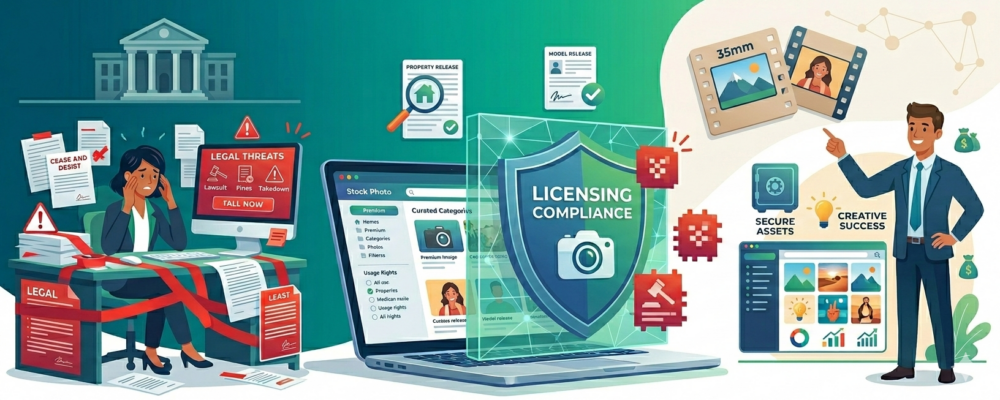
Stock Photography Done Right: Avoiding Legal Pitfalls and Finding Reliable Resources
Posted on Stock Photography | Copyright

- Google Images is not a free stock library. Visibility does not equal permission.
- Stock agencies embed metadata and use digital fingerprinting to track unauthorized image use, even if files are resized or altered.
- Reputable sources like Getty, Shutterstock, Adobe Stock, Unsplash, Pexels, and Pixabay offer clear licensing, sketchy “free download” sites do not.
- The cheapest image is often the most expensive if you don’t understand the license.
There’s a moment that still makes my stomach tighten.
A client forwards an email. Subject line: Unauthorized Image Use. The tone is polite, almost friendly, and then you get to the number. Four figures. Sometimes five. For a photo, someone on their team grabbed from “Google.”
And just like that, what felt like a harmless shortcut turns into a very expensive lesson.
After 33 years in this business, we’ve seen stock photography evolve from 35mm slides in manila envelopes to instant downloads in under ten seconds. What hasn’t changed is this: using images incorrectly can cost you. Not just money, but credibility.
Let’s talk about how to do this right.
Back When Stock Photography Was Physical
If you started your career in the last fifteen years, this is going to sound prehistoric.
In the early 1990s, stock photography meant catalogs. Thick ones. Phone-book thick. You’d flip through glossy pages with tiny thumbnails and handwritten codes. When we found something promising, we’d call a rep or a researcher.
A few days later, a package would arrive. Inside? 35mm slides.
Actual slides.
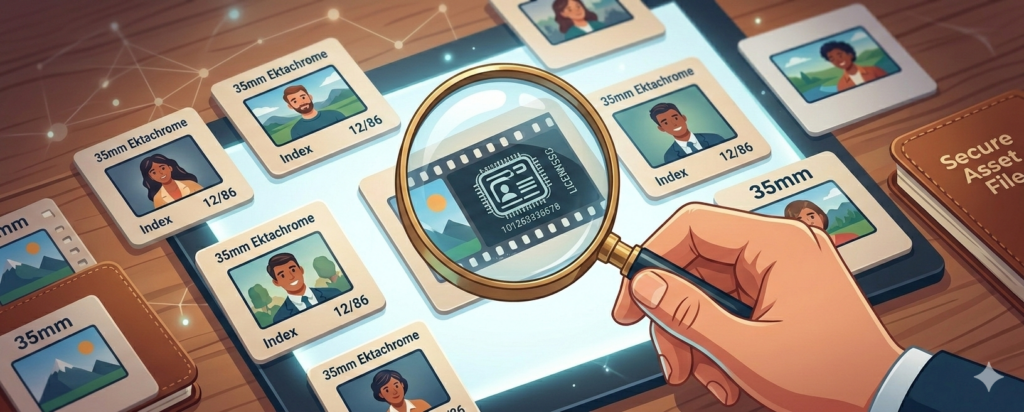
We’d take those slides, carefully organized in little plastic sleeves, and physically bring them to a client’s office. We’d sit around a conference table, dim the lights, load a carousel projector, and click through image after image on a wall.
When the client made a selection, we licensed that specific image for a specific use. Print run. Region. Duration. Everything was defined.
It was slower. It was more deliberate. And ironically, it was clearer. Nobody assumed an image was “free.” There was no illusion that visuals were just floating around the internet for the taking.
You paid for photography. Period.
Then the Internet Happened
Suddenly, images were everywhere. High resolution. Instantly accessible. No researcher. No slides. No courier.
And with that convenience came confusion.
Somewhere along the way, people started equating “I can see it” with “I can use it.”
That’s where things go sideways.
Why Google Images Is Not a Free Photo Library
This one needs to be said plainly.
Google Images is a search engine. It is not a stock photography site.
When you search Google Images, you’re seeing content indexed from across the web. Most of those images are owned by someone. A photographer. A publication. A brand. A designer.
Downloading an image from Google Images and putting it on your website without permission is the digital equivalent of walking into a bookstore, grabbing a framed print off the wall, and taking it home because “it was visible.”
It doesn’t work that way.
Yes, Google has usage filters. No, they are not foolproof. We’ve seen filtered “free to use” images that were absolutely not free to use. The liability sits with the user, not Google.
If you’re running a business, the risk isn’t theoretical.
What Happens When You Use an Image Without Permission
We’ve seen the full range.
A polite request to remove the image.
A retroactive licensing demand for a few hundred dollars.
A formal demand letter from an agency representing the photographer.
And in some cases, a legal escalation.
There are firms and monitoring services whose entire business model revolves around tracking unauthorized image use. They use reverse image search technology that is far more sophisticated than anything most business owners are thinking about.
The logic from their side is simple: that image is their intellectual property. If you used it commercially without permission, you owe them.
And here’s the part that surprises people. It doesn’t matter if:
• You didn’t know
• Your intern did it
• It was “just a blog post”
• You gave credit
• You found it on Pinterest
Intent doesn’t override copyright.
If the image is on your website, you’re responsible.
The Metadata and Tracking Most People Don’t Know About
Here’s where it gets even more interesting.
Many major stock photo agencies embed metadata directly into image files. That can include the photographer’s name, copyright information, licensing data, agency identifiers, and unique image IDs. Even if you don’t see it, it’s often sitting inside the file.
But that’s only part of the story.
Agencies like Getty Images and Shutterstock also use digital fingerprinting technology. That means the image has a kind of visual DNA. Resize it, crop it, compress it, even strip the metadata, and it can still be identified.
There are entire enforcement services that crawl the web, match image fingerprints, cross-check licensing records, and issue settlement notices automatically.
In other words, the old assumption that “no one will notice” is outdated.
Even if metadata is removed during upload or compression, the copyright doesn’t disappear. Ownership doesn’t vanish because someone right-clicked and saved.
This is not scare tactics. It’s just how the system works now.
The Real Cost Isn’t Just the Invoice
The financial hit hurts.
But there’s something else at stake: trust.
If you’re a professional services firm, a nonprofit, a hospitality brand, or a public entity, and you’re careless with intellectual property, what does that signal?
It says you cut corners.
We’ve built our reputation over three decades on doing things the right way, even when it takes longer. That applies to photography too.
Because good creative work isn’t just about aesthetics. It’s about ethics.
So Where Should You Get Images?
Let’s break this down into three categories: paid stock libraries, reputable free libraries, and custom photography.
1. Paid Stock Libraries
If you want breadth, consistency, and clear licensing, paid platforms are still the most predictable route.
Some reliable sources include:
• Getty Images
• Shutterstock
• Adobe Stock
• iStock
These platforms define licensing clearly. You know what you’re buying. You can select standard or extended rights depending on how the image will be used.
They’re not free. But they’re safe.
And in a commercial environment, safe is valuable.
2. Reputable Free Stock Sources
Free can be legitimate, if you’re using the right platforms.
A few well-known sources include:
These sites generally allow commercial use under their license terms. That said, always:
• Review the specific license
• Avoid recognizable brands or logos
• Be cautious with identifiable people unless releases are clear
• Avoid images that feel staged for sensitive industries
And here’s the important caution.
There are countless “free download” sites that scrape content from legitimate platforms. If a site looks overloaded with ads, offers premium agency images for free, or doesn’t clearly explain licensing, step away.
Free is fine. Sketchy is not.
3. Custom Photography
Stock photography is convenient. Custom photography is powerful.
Some of the strongest brand work we’ve done involved hiring photographers to capture real people, real locations, real moments.
In the early days, we had relationships with stock photographers. We knew their styles. We trusted their work. They’d send curated slide selections. It felt collaborative.
Today the format has changed, but the principle hasn’t.
Original photography:
• Builds authenticity
• Creates exclusivity
• Eliminates duplication across competitors
• Strengthens brand equity
We’ve seen the same “smiling call center rep” appear across five competing websites. That doesn’t build credibility. It builds sameness.
Original imagery separates you.
What About AI-Generated Images?
AI-generated visuals are part of the landscape now.
They can be useful. Flexible. Cost-effective.
But they also come with licensing terms that vary by platform. Before using AI-generated images commercially, confirm that the platform grants commercial rights and understand how your brand will be perceived using synthetic imagery.
AI is a tool. It’s not a free pass around intellectual property responsibility.
A Simple Framework for Safe Image Use
If you want this to be manageable, here’s a straightforward approach:
Create an approved source list
Centralize image downloads
Store license confirmations
Ban Google Image grabbing internally
Budget annually for original photography
This isn’t about being overly cautious. It’s about being consistent.
We’ve Seen the Cleanup Jobs
Over 33 years, we’ve been brought in after the issue surfaced.
The “we just got a letter” call.
The scramble to replace dozens of images across an entire site.
The uncomfortable internal conversation explaining how a $0 shortcut became a multi-thousand-dollar invoice.
It’s avoidable.
Every single time.
The Irony of “Free”
In the 1990s, we spent time and real dollars sourcing the right image. It was deliberate. Thoughtful. Licensed.
Today, you can find a stunning image in seconds.
But access is not ownership.
And that’s the line that matters.
Stock Photography Done Right Is Boring, and That’s a Good Thing
The best stock strategy doesn’t create drama.
No demand letters. No surprise invoices. No frantic site updates.
Just properly licensed visuals supporting a strong brand.
It’s not flashy. It’s responsible.
And responsibility compounds. The same companies that respect intellectual property tend to respect brand standards, accessibility, SEO structure, and user experience too.
It’s a mindset.
From Slides to Search Bars
When I think back to carrying 35mm slides into client meetings, it feels like another world.
But one thing hasn’t changed.
Images shape perception instantly. They communicate trust, professionalism, and credibility before a single word is read.
The technology evolved. The responsibility didn’t.
If you’re going to represent your brand visually, do it intentionally. Use reputable sources. Understand licensing. Invest in original photography when it matters.
Because the cost of doing it right is predictable.
The cost of doing it wrong rarely is.
After 33 years, we’ll take predictable every time.