

7 Reasons Custom WordPress Development Outperforms Page Builders
Posted on WordPress | Page Builders

Estimated reading time: 5 minutes
Why Performance is the New Currency
In the early days of the web, having a website was enough. Today, your website is often the first—and sometimes only—interaction a customer has with your brand. As search engines like Google evolve to prioritize User Experience (UX) through metrics like Core Web Vitals, the technical foundation of your site has become a primary ranking factor.
Many businesses fall into the “Page Builder Trap,” choosing tools like Elementor or Divi for their initial ease of use. However, as your traffic grows and your digital strategy matures, the limitations of these platforms—code bloat, security vulnerabilities, and slow load times—begin to act as a ceiling on your growth.
Is your website a growth engine or a digital anchor? While page builders like Elementor or Divi are popular for quick fixes, high-growth brands are increasingly moving toward custom WordPress builds.
Here is why custom development is the secret weapon for businesses that outpace their competition.
1. Blazing Fast Load Times (The Google “Speed” Factor)
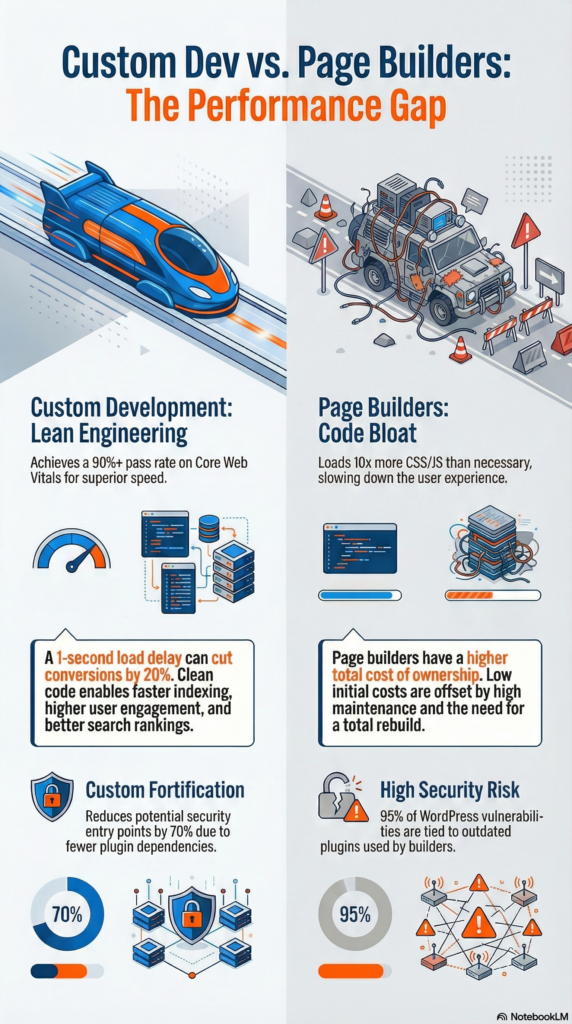
Page builders come with “bloat”—massive amounts of unnecessary code that loads in the background. In 2026, Google’s Core Web Vitals are stricter than ever.
- The Difference: A custom site only includes the code your specific features need.
- The Result: Faster page loads, lower bounce rates, and a significant edge in SEO rankings.
2. Unrivaled Security in a High-Risk Landscape
Generic page builders are massive targets for hackers because one vulnerability can affect millions of sites.
- The Difference: Custom themes are built with “clean” code, reducing the surface area for attacks.
- The Result: Less reliance on third-party plugins (which are the #1 source of WordPress hacks), keeping your data and your customers’ information safe.
3. Total Creative Freedom (No More “Template” Look)
Template-based sites often look like… well, templates. If your competitor uses the same builder, your brands might look like cousins.
- The Difference: With custom development, the design follows your brand identity, not the restrictions of a drag-and-drop tool.
- The Result: A unique digital “handshake” that builds immediate trust and authority with your visitors.
4. Scalability: A Site That Grows With Your Business
Page builders often “break” or slow down when you try to add complex features like custom portals, advanced GEO-targeting, or deep CRM integrations.
- The Difference: Custom WordPress sites are built to be modular. We build the foundation today for the features you’ll need tomorrow.
- The Result: You won’t have to rebuild your entire site in two years just because your business evolved.
5. Superior “Editability” for Your Team
Ironically, “easy” page builders can be a nightmare for non-technical staff to update without breaking the layout.
- The Difference: We use Gutenberg Blocks tailored to your brand. Your team gets a “fill-in-the-blanks” editing experience that makes it impossible to ruin the design.
- The Result: Your marketing team spends less time fixing layouts and more time publishing content.
6. Native SEO Superiority
Search engines love clean “semantic” HTML. Page builders often bury your content under layers of unnecessary “div” tags, making it harder for Google to understand what your page is about.
- The Difference: Custom builds allow us to prioritize the hierarchy of information exactly how search engines want it.
- The Result: Better indexing and higher visibility for your most competitive keywords.
7. Lower Long-Term Total Cost of Ownership (TCO)
While page builders are cheaper on day one, the costs of plugin subscriptions, constant maintenance, and “fixing” speed issues add up.
- The Difference: A custom site is a high-performance asset that requires fewer “band-aids” over its lifespan.
- The Result: More of your budget goes toward marketing and growth rather than technical debt and maintenance.
Frequently Asked Questions About Custom WordPress Development
Is a custom WordPress site harder for my team to manage than a page builder?
Actually, it’s easier. Page builders often provide too many options, which leads to “design drift” and broken layouts. Custom builds use tailored Gutenberg Blocks—think of it as a “branded toolkit” where your team just fills in the content, and the site handles the perfect formatting automatically.
How long does a custom WordPress build typically take compared to a template?
While a template can be “launched” in days, it often takes weeks of tweaking to fix performance issues. A custom Visionary build typically takes 8 to 12 weeks. This includes a deep discovery phase, custom UX design, and rigorous performance testing to ensure the site is an asset, not just a placeholder.
Can I migrate my existing content from Elementor or Divi to a custom build?
Yes. During our migration process, we audit your existing content and map it to your new, clean architecture. This is actually the best time to perform an SEO Content Audit to ensure your top-performing pages gain even more traction after the move.
Will a custom WordPress website really improve my SEO rankings?
Coding is only one part of SEO, but custom development removes the “technical ceiling” that holds many sites back. By eliminating code bloat and optimizing for Core Web Vitals from day one, you provide search engines with a clear, fast, and authoritative source to index—often resulting in higher rankings and lower cost-per-click in paid campaigns.