Winning the One Spot: How Local Businesses Can Show Up in Google’s AI Search
Posted on Local SEO | Google 3-Pack

Part 2 of a two-part series on the future of local search | Digital Horizons by Visionary
In Part 1, we laid out the uncomfortable news: Google’s AI is replacing the familiar Local 3-Pack with AI-generated results that often recommend just one business, frequently hide the call button, and answer customers without sending them anywhere. Fewer visible spots, more zero-click searches, and rank reports that look fine while the phone goes quiet.
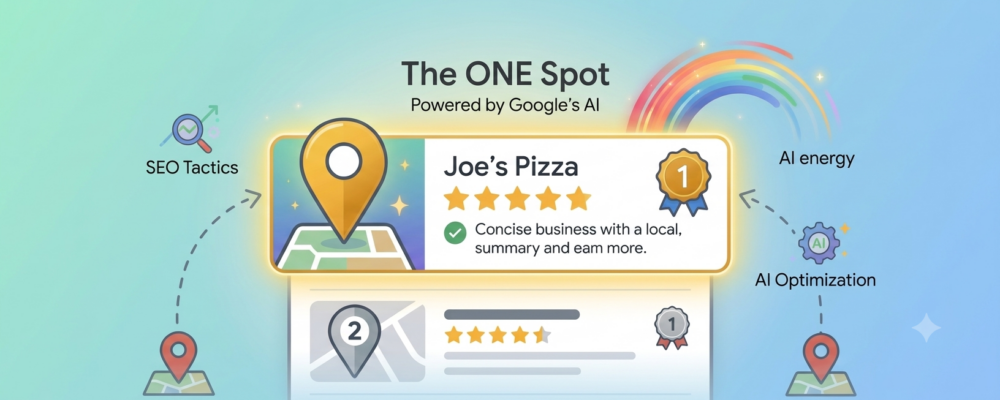
So here’s the question that actually matters: if the AI is only going to name one business, how do you become that business?
The encouraging part is that the AI isn’t picking at random. It’s reading signals — most of which you can influence. And here’s the reassurance for busy owners who wear ten hats: this is not a brand-new discipline you have to learn from scratch. Google itself said so in 2026, publishing official guidance that boils down to a single line — optimizing for AI search is still SEO. The fundamentals still win. The bar is just higher, and a few priorities have shifted.
Here’s your practical playbook, in the order we’d tackle it.
First, Understand How the AI Decides
The old 3-Pack ran on three factors Google states openly: relevance (how well you match the search), distance (how close you are to the searcher), and prominence (how well-known and well-regarded you are). Those still matter. But the AI layer adds something important on top.
Instead of ranking listings, Google’s AI increasingly ranks entities — it reads your Google Business Profile, your website, your reviews, your social profiles, and your mentions across the web as one connected picture of who you are. When that picture is complete, consistent, and clearly the best answer to the question, you’re the one it names. When the picture is patchy or contradictory, the AI defaults to a competitor whose story is cleaner.
That single insight drives everything below.
The playbook: what to actually do
1. Own your Google Business Profile completely
This is still the heaviest lever you control, and it feeds both the traditional pack and the AI. Get the basics airtight:
- Primary category is correct — this is the single most important individual ranking factor. Choose the one that best describes your core business, then add relevant secondary categories.
- Every service and product listed, described in plain language customers actually use.
- Accurate hours (being marked “closed” when you’re open can quietly sink you).
- 30+ real photos, refreshed regularly.
- Steady activity — posts, Q&A, updated info. A living profile beats a dormant one.
2. Win on recent, detailed reviews
Reviews now do double duty. They influence rankings and the AI literally reads the text of them to match businesses to queries. A review that says “they fixed my burst pipe at 11pm on a Sunday” is training data telling Google you’re the answer for emergency plumbing.
Aim for a steady stream of recent reviews (many customers now filter for the last 90 days), keep your average at 4.5 stars or above, encourage reviewers to mention specific services, and reply to every review — good and bad — promptly.
3. Make your business information identical everywhere
Your Name, Address, and Phone number (NAP) should match exactly across your website, Google Business Profile, Apple Maps, Bing, Yelp, the Better Business Bureau, and any industry directories. Contradictions — an old phone number here, a suite number missing there — are exactly the kind of thing that makes the AI lose confidence in you and pick someone tidier. Run an audit, fix the mismatches, keep it consistent.
4. Build content that answers real customer questions
Remember from Part 1 that AI Overviews dominate informational and hybrid searches — the “how much does X cost,” “how long does Y take,” “what should I do about Z” questions. Whitespark’s research found AI Overviews appearing on 92–97% of those query types. That’s your opening.
Create genuinely useful service pages, location/city pages, and FAQ or guide content that answers the questions your customers actually ask before they buy. This is the content the AI cites — and, unlike a directory listing, it’s something you fully own. Google’s own guidance is blunt here: publish unique, non-commodity content, not thin filler.
5. Earn mentions on the sites the AI reads
Because the AI pulls from third-party sources, your presence beyond Google matters. Get listed and reviewed on the platforms relevant to your industry, earn a mention in local news or community sites, and maintain an authentic presence where your customers already talk (yes, including Reddit for some industries). You’re not gaming anything — you’re making sure the wider web tells a consistent, positive story about you.
6. Make your website “agent-ready”
Google’s AI is starting to act on customers’ behalf — even calling businesses and booking appointments. Make sure it can work with your site: use real, clickable buttons and links (not a phone number baked into an image), keep contact and booking paths simple, ensure the site is fast and mobile-first, and add LocalBusiness schema markup where it fits. If a machine can’t easily read and use your site, it can’t recommend or transact with you.
Don’t Put All Your Eggs in the Organic Basket
Here’s the honest strategic advice: as free organic spots shrink and ads expand, smart local businesses are diversifying rather than betting everything on being the one AI pick.
- Test Google Ads and Local Services Ads. These retain the call buttons and premium placement that organic listings are losing. Measure the return against your declining organic calls — for many businesses the math now favors paying for some of that visibility back.
- Consider more locations or service areas if it fits your model. When the AI narrows the field, each legitimate location is another “lottery ticket” in the results.
- Build owner and brand authority off-search — a YouTube channel, a genuinely helpful presence in your community and industry. As AI eats search, being a known name is a hedge that pays off no matter which way the SERP turns.
Measure the Right Things
Finally, change what you track. Rankings alone will lie to you now, because most tools can’t see the AI results real customers see. Instead, make calls, form fills, bookings, and direction requests your primary scorecard. Watch your mobile click-to-call trend especially closely — if it’s falling year-over-year while your rankings hold steady, that’s the AI Local Pack quietly at work in your market, and your signal to accelerate the playbook above.
The Bottom Line
The shift from three spots to one is real, and it rewards the prepared. The businesses that win the one spot aren’t doing anything exotic — they’ve simply made themselves the obvious, best-documented, most consistent answer to the customer’s question across every place the AI looks. Complete profile, great recent reviews, consistent information, genuinely useful content, a presence beyond Google, and a website a machine can actually use.
It’s still SEO. It’s just SEO with higher stakes — and a much bigger reward for getting it right.
The New Local Search Playbook
How Google’s AI is replacing the Local 3-Pack with a single recommendation — plus a step-by-step checklist to become the business it chooses. Get the full breakdown your team can act on this week.
Download the free PDFFrequently Asked Questions
What’s the single most important thing I should do first?
Start with your Google Business Profile, and specifically your primary category — it’s the most influential individual factor and it feeds both the traditional pack and the AI. From there, make sure your profile is complete (services, hours, photos, regular activity) and launch a habit of steadily collecting recent, detailed reviews. Those two moves — a complete profile and a healthy flow of fresh reviews — give you the biggest return for the least complexity, which matters when you’re a small team wearing multiple hats.
Do I need special AI files, schema, or “AI optimization” tricks?
No — and be skeptical of anyone selling that. Google published official guidance in 2026 stating there’s no special schema or “chunked” content you need to add for AI search, and that chasing artificial “mentions” isn’t as helpful as it looks. What works is ordinary good SEO done well: a complete Business Profile, strong reviews, consistent business information, and unique, useful content. LocalBusiness schema is worth adding as a general best practice, but there’s no secret AI file that changes your fortunes.
Should I start paying for Google Ads now?
It’s worth testing, yes. As organic spots shrink and the free call buttons disappear, Google Ads and Local Services Ads keep the premium placement and click-to-call that organic listings are losing. The right move is to run a measured pilot and compare the cost per call against what you’re losing organically. For many local businesses, the balance has tipped toward buying back some of that visibility — but treat it as an experiment with real numbers attached, not a blank check.
How do I know if this is actually affecting my business?
Watch your calls, not just your rankings. Pull your Google Business Profile insights and look at the mobile click-to-call trend over the past year or two. If calls are sliding while your ranking reports say you’re holding steady in the top three, that gap is the tell-tale sign of AI Local Packs at work — you’re “ranking” in a box fewer people see. Also try searching your top few services on your phone in an incognito window and see what actually shows up: an AI answer, a single recommendation, or the old 3-Pack. Screenshot it monthly to track how your market is changing.