

Answer Engine Optimization (AEO), Explained: How It Differs from SEO and GEO

- AEO is optimizing to be the answer, not just a link. Answer Engine Optimization aims to get your content chosen as the direct response to a question.
- SEO, AEO, and GEO aren’t rivals. There’re three lenses on the same shift: SEO earns rankings, AEO earns the answer, and GEO earns a place in AI-generated responses.
- The acronyms overlap, and that’s fine. Chasing the labels is a distraction; the underlying work is largely the same, and it compounds.
- This is where the clicks are going. As answer engines resolve more questions directly, being the sourced answer is how you stay visible.
- It runs on fundamentals, not tricks: clear question-and-answer content, structure, verifiable facts, and a business machines can trust.
If you’ve spent any time reading about AI and search lately, you’ve been hit with an alphabet soup: SEO, AEO, GEO, and now AIO. Every few months, a new three-letter acronym arrives, usually with a breathless claim that it’s replacing everything that came before, and usually from someone selling a course on it.
Here’s the calm version. These acronyms describe real, overlapping shifts in how people find businesses, and one of them, AEO, is worth understanding because it names something happening to your traffic right now. But you don’t need to pick a camp or chase a buzzword. You need to understand what each term points to, and then do the work that serves all of them at once.
Let’s start with the one causing the most confusion.
So What Is Answer Engine Optimization?
Answer Engine Optimization, or AEO, is the practice of optimizing your content so it is selected as the direct answer to a question, rather than just one of ten blue links a searcher has to sort through.
The key word is answer. Traditional search hands you a list and makes you do the work: click, read, evaluate, click again. An answer engine does the work for you and returns a response. Featured snippets were an early version of this. Voice assistants pushed it further, reading a single answer aloud. Today’s AI answer engines, including Google’s AI Mode and AI Overviews, ChatGPT, Perplexity, and Gemini, are the fullest expression: you ask, they answer, often without you visiting anyone’s website at all.
AEO is the discipline of making your business the source of that answer. It means structuring your content around the real questions your customers ask, answering them clearly and concisely near the top of the page, backing those answers with specifics that an engine can lift and trust, and formatting them so a machine can extract them cleanly. When someone asks “what’s the difference between a heat pump and a furnace” or “how long does a commercial roof last,” AEO determines whether your content is the answer they get, with your name attached.
For a small or mid-sized business, that’s a profound shift. You no longer win purely by ranking. You win by being the clearest, most trustworthy answer to a specific question.
How AEO Differs from SEO
Traditional SEO, or Search Engine Optimization, is about earning visibility in the list of results. You optimize a page to rank for a keyword, and success looks like ranking first, getting a click, and driving a visit. It has powered digital marketing for two decades, and it is not going away.
AEO sits on top of SEO rather than replacing it. Where SEO asks “how do I rank for this keyword,” AEO asks “how do I become the answer to this question.” The difference shows up in how you build content. SEO thinking produces a page targeting “commercial HVAC maintenance.” AEO thinking produces a page that also cleanly answers “how often should commercial HVAC be serviced” in a way a search engine can quote.
Crucially, AEO depends on SEO. An answer engine can only draw on content it can find, crawl, and deem credible, which is the job SEO has always done. Think of SEO as earning your place in the race, and AEO as earning the moment of being chosen. You need both. Skipping the fundamentals to chase the answer box is like entering a race you never qualified for.
How AEO Differs from GEO (and Where AIO Fits)
Here’s where the alphabet soup thickens, so let’s keep it simple.
GEO, Generative Engine Optimization, is about being included and cited in AI-generated responses, the paragraphs that tools like ChatGPT, Gemini, and AI Overviews compose on the fly by synthesizing information from many sources. GEO’s question is “how do I get referenced and named when the AI writes its answer?” (We cover the SEO-to-GEO shift in depth in our companion piece on the new rules of GEO.)
The honest truth is that AEO and GEO overlap heavily, and the industry uses the terms inconsistently. A reasonable way to hold them: AEO is the broader idea of being the answer across featured snippets, voice, and AI, while GEO is specifically about earning your place in generative AI outputs. AIO, which you’ll see used for both “AI Optimization” and “AI Overviews optimization,” is usually just another label for the same territory.
If that sounds like a lot of overlapping circles, that’s because it is, and it’s the most important thing to understand about all of this. The acronyms are marketers drawing slightly different boundaries around one underlying change: search is shifting from returning links to returning answers, and businesses have to optimize to be those answers. Arguing about where AEO ends and GEO begins is a great way to feel busy without accomplishing anything. The work that makes you the answer is, in practice, the work that gets you cited by AI.
Why the Answer Now Beats the Link
If this felt like a nice-to-have a couple of years ago, behavior data has caught up. According to SimilarWeb, roughly 69% of Google searches now end without a click, up from about 56% before AI Overviews launched in mid-2024. A Pew Research study of nearly 68,000 real search sessions found that when Google shows an AI summary, users click a traditional result only about 8% of the time, compared with 15% when no summary appears. Bain & Company estimates that AI-driven zero-click behavior is pulling organic traffic down by 15% to 25% for many sites.
Read those numbers together, and the strategic picture is clear. The link you worked hard to rank is getting fewer clicks because the answer is increasingly delivered on the results page or within an AI tool. That doesn’t mean demand disappeared; it means the point of capture shifted. If your content is the answer shown, you’re still winning the moment and often winning a warmer prospect, because the engine effectively pre-qualified them. If it isn’t, you’re losing a customer you never see. AEO is simply the discipline of being on the right side of that shift.
The Nuance That Separates Experts From Everyone Else
Here’s where most “AEO vs GEO” articles lead you astray. They frame it as a choice, as if you should reallocate your effort from one acronym to another. You shouldn’t. The experts don’t optimize for AEO, GEO, or SEO as separate campaigns. They do a set of things that happen to serve all three.
What are those things? Answer real questions directly and early on the page, rather than burying the payoff in 400 words of preamble. Support every claim with specific, verifiable facts and figures, because engines prefer sourceable specifics over vague assertions. Structure content with clear headings and, where it fits, use question-and-answer formatting and FAQ schema so machines can extract clean answers. Make your business a well-defined, consistently described entity so engines trust the source. And keep the technical foundation sound so everything you publish can be found and read.
Notice that none of those are acronym-specific. A page built that way ranks well in SEO, wins featured snippets and voice answers under AEO, and gets cited by generative engines under GEO. That’s the whole game: the fundamentals are shared, and doing them well pays off across every flavor of AI search at once. The businesses that win aren’t the ones who guessed the right acronym. They’re the ones who did the durable work while everyone else argued over labels.
What This Looks Like for a Real Business
Let’s make it concrete. Say you run marketing for a mid-sized accounting firm. Under old-school SEO, your strategy was a page targeting “small business accounting services” and a keyword-stuffed blog, aimed at ranking and driving clicks.
An AEO approach changes what you publish. Now you build content around the actual questions prospects ask: “Do I need a CPA or a bookkeeper?” “How much should a small business spend on accounting?” “When should I switch from cash to accrual accounting?” Each answer is stated plainly and early, backed by specifics, and structured so an engine can lift it cleanly. You add FAQ schema so machines know exactly what’s being answered. You ensure your firm is described consistently everywhere, so the engines trust you as a source.
The payoff shows up across the board. You still rank in traditional results. But now you also surface when someone asks Google’s AI Mode about switching accounting methods, and your firm gets named when a prospect asks ChatGPT to recommend an accountant for their situation. The same is true whether you’re a manufacturer answering spec questions, a professional services firm explaining your process, or a non-profit answering “How can I help?” The businesses that get chosen are the ones that answered the question clearly and earned the trust to be quoted.
Why a WordPress Site Makes This Easier
AEO leans on structure, and a well-built WordPress site is a strong foundation for implementing it. Clean heading hierarchy, question-based subheadings, FAQ and Article schema, fast and crawlable pages, and logical internal linking are exactly the levers that make content extractable as answers, and they’re straightforward to implement and maintain on WordPress.
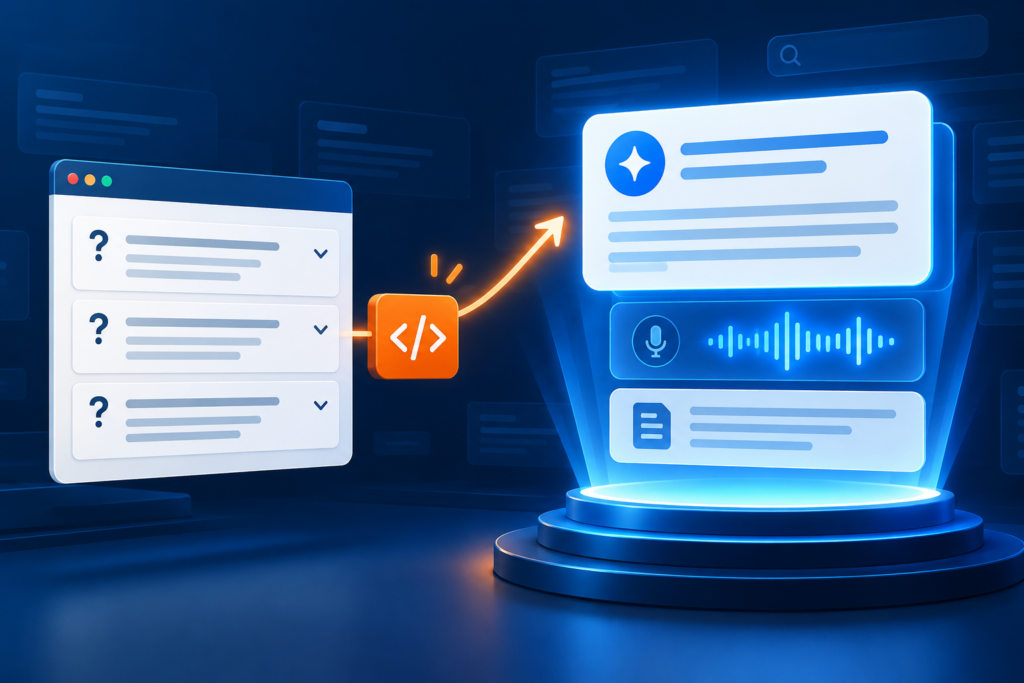
FAQ schema deserves special mention because it’s one of the highest-return, lowest-effort moves in AEO. Marking up your question-and-answer content tells engines exactly what’s being asked and answered on a page, making your answers far easier to lift into a snippet or an AI response. It’s a small technical step with an outsized payoff, and it’s a natural fit for a WordPress site already organized around real customer questions. These fundamentals also support accessibility and traditional SEO, which is the recurring theme of real AI Search Optimization: the work compounds and is built on solid ground rather than gimmicks.
The Recurring Part That Changes Everything
AEO is not a one-time project. The questions your customers ask evolve, competitors publish their own answers, and the engines constantly change how they select and display responses. What earns the answer this quarter needs reinforcement next.
Effective AEO is a monthly practice. Each month, you identify new questions worth answering, deepen and update the answers you already own, tighten the structure and schema, and strengthen the trust signals that make engines confident in quoting you. The results compound: the more questions you’re the clear answer to, the more visible you become across SEO, AEO, and GEO alike, and the harder you are to displace.
So don’t get lost in the acronyms. AEO, GEO, and AIO are three views of the same shift, from a search that returns links to one that returns answers. Your job isn’t to bet on the right three letters. It’s to become the answer, clearly and consistently, so that whichever engine a customer uses and whatever the marketers are calling it that month, the response they get is yours.
Frequently Asked AEO Questions
What is Answer Engine Optimization (AEO) in plain terms?
AEO is optimizing your content so it is chosen as the direct answer to a question, rather than just appearing as one link in a list. Traditional search returns ten results and makes you sort through them; an answer engine, a featured snippet, a voice assistant, or an AI tool like ChatGPT or Google’s AI Mode returns a single response. AEO is the work of making your business the trusted source of that response: answering real customer questions clearly and early, backing them with verifiable specifics, and structuring them so a machine can extract them cleanly.
What’s the actual difference between SEO, AEO, and GEO?
Think of them as three lenses on the same shift. SEO (Search Engine Optimization) focuses on earning visibility in search results. AEO (Answer Engine Optimization) focuses on being selected as the answer to a question, across snippets, voice, and AI. GEO (Generative Engine Optimization) focuses on being cited in AI-generated responses from tools like ChatGPT and Gemini. AIO is usually just another label for the same AI territory. They overlap heavily, and the industry uses them loosely, so the practical takeaway is that they’re facets of one change rather than competing strategies you must choose between.
Should I focus on AEO instead of SEO now?
No, and framing it as an either/or is the common mistake. AEO sits on top of SEO; it doesn’t replace it. An answer engine can only select content it first finds, crawls, and trusts, which is exactly what SEO delivers. The good news is you don’t have to split your effort: the work that makes you the answer, including clear question-and-answer content, verifiable facts, clean structure and schema, and a trustworthy, well-defined business, is the same work that earns rankings and gets you cited by AI. Do the fundamentals well, and you’re optimizing for all of them at once.
How do I know if AEO is working when people don’t click?
This is the real measurement challenge in answer-based search, and it’s why traditional click tracking falls short. Watch a combination of signals rather than a single number: whether your business appears and is cited when you run your customers’ real questions through ChatGPT, Perplexity, and Google’s AI Mode; whether branded searches and direct traffic rise as AI surfaces you more; and whether AI-referred visits (often misfiled as “direct”) appear in your analytics. Reviewed monthly, those signals tell you whether you’re winning the answer, even when the click never happens.
Wondering whether your business is the answer, or just another link?
Most companies have never checked whether AI answer engines actually surface and recommend them for the questions their customers ask. We audit how you show up across AI search, rebuild your content to be chosen as the answer, and add the structure and trust signals that get you cited.
Get a free AI Search Visibility Audit. We’ll show you which questions you’re winning, which you’re losing, and where a competitor is named instead.
We are custom WordPress developers specializing in AI Search Optimization, SEO, ADA Compliance, and Digital Marketing. Our monthly programs are built for how people and AI find businesses today, because being the answer is ongoing work.