
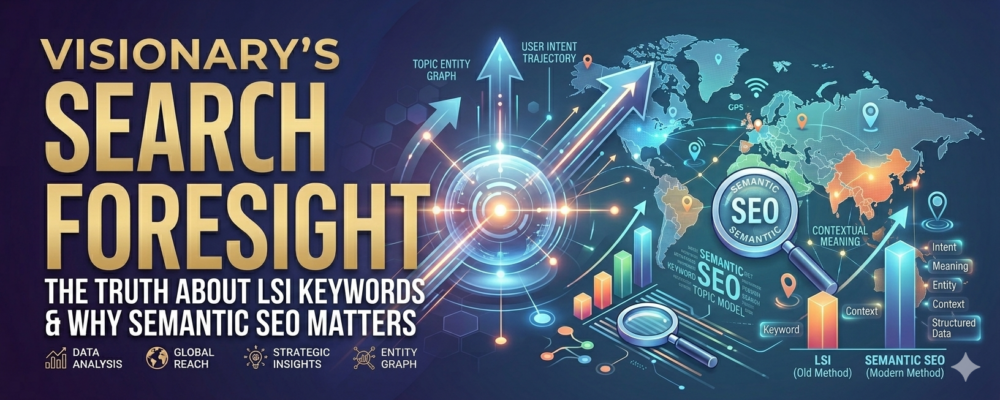
The Truth About LSI Keywords and Why Semantic SEO Matters More Than Ever
Posted on Latent Semantic Indexing | Semantic Search | SEO

- “LSI keywords” is an outdated SEO phrase, but the practical idea behind it still matters: related words and phrases help search engines understand the full context of a page.
- Google does not use the old LSI model as a ranking factor. It uses far more advanced systems, including BERT, RankBrain, and MUM, to understand meaning, intent, and context.
- Semantically rich pages can rank for many related searches, not just one target keyword, which creates more opportunities to earn qualified organic traffic.
- This is monthly work, not a one-time fix. Search behavior changes, competitors publish new content, and Google’s understanding of a topic evolves over time.
Many small-business websites are leaving Google traffic on the table for a surprisingly simple reason: they are still optimized for how search engines worked a decade ago.
Back then, SEO often meant picking a keyword, say “plumber in Chicago,” and repeating it as often as possible across a website. Sites that did this often ranked. Businesses that did not fell off the map. It was blunt and mechanical, and eventually Google got much smarter.
Today’s Google is something else entirely. Understanding that shift is what separates a website that quietly generates leads every month from one that remains invisible on page four.
So What Are LSI Keywords?
LSI stands for Latent Semantic Indexing, a term borrowed from information science. In SEO conversations, people often use it to describe related words and phrases that tend to appear together when discussing a topic.
If your main keyword is “Italian restaurant,” semantic keywords might include “pasta,” “reservations,” “wine list,” “gluten-free options,” and “private dining.” None of these replace your main keyword. Together, they signal that your page genuinely covers the topic in depth, rather than that someone typed “Italian restaurant” into a text box fifty times.
Think of it this way: if you overheard someone talking about baseball but they never mentioned “bat,” “pitcher,” “innings,” or “outfield,” you would think something was off. Google evaluates web pages similarly. A page should sound like it truly understands the subject it is trying to rank for.
The Nuance That Separates Experts From Everyone Else
Here is where the terminology gets muddy.
Google representatives have repeatedly pushed back on the term “LSI keywords” as an SEO ranking tactic. John Mueller, a Google Search Advocate, has said that Google does not use LSI keywords as a direct ranking factor. The mathematical model that gave LSI keywords their name was developed decades ago and does not reflect how modern Google Search understands content at scale.
So does that mean related keywords do not matter? No. It means the label is outdated.
What Google uses is far more sophisticated: BERT, RankBrain, and MUM, artificial intelligence systems designed to understand language, context, and intent. When BERT was first announced, Google said it would help Search better understand one in 10 English-language searches in the U.S. Google later said BERT was being used in almost every English-language query. MUM, another Google language model, was introduced as being 1,000 times more powerful than BERT and trained across 75 languages.
These systems do not simply count keywords. They evaluate meaning. They analyze the full context of your content, the relationships between concepts, and how completely your page answers what a person is truly looking for.
Using semantically related keywords, which is what most people mean by “LSI keywords,” is how you give those systems the context they need. The old label may be inaccurate. The strategy remains foundational to modern SEO.
What This Looks Like for a Real Business
Let’s say you own a law firm specializing in personal injury. Your homepage targets the keyword “personal injury lawyer.”
A keyword-stuffed page repeats that phrase until it sounds robotic. A semantically rich page also naturally covers “car accident attorney,” “medical bills after an accident,” “how long does a personal injury claim take,” “settlement negotiation,” and “no win, no fee.” Not because someone forced them in, but because a genuinely comprehensive page on personal injury law would naturally discuss these topics.
That semantic depth signals to Google that the page truly understands personal injury law. The result is broader visibility. You are not only chasing one keyword; you are giving the page a better chance to appear for related searches at different stages of the customer journey.
Why Your WordPress Website Is Your Biggest SEO Asset, If It Is Built Right
WordPress, when custom-built and properly maintained, is one of the most SEO-friendly platforms available. But “properly” is the operative word.
A well-architected WordPress site lets you build semantic depth into your content structure from the ground up, including headings, internal linking, schema markup, and page architecture that communicates topical authority to search engines at every level.
This is also where ADA compliance intersects with SEO in ways many businesses overlook. Proper heading hierarchy, descriptive alt text, clear navigation, and meaningful link text are not just accessibility considerations. They also make content easier for search engines to understand and for people to use.
Google’s own documentation states that indexing includes analyzing page text and key content attributes, such as title elements and alt attributes. Google’s image guidance also notes that alt text provides important image metadata and improves accessibility for users who cannot see images on a page.
In plain English: a website built with accessibility in mind is often a website built with better SEO fundamentals.
The Recurring Part That Changes Everything
Here is what most one-time SEO projects miss: search behavior changes. Google updates its systems. Competitors publish new content. What is semantically relevant in your industry shifts month to month.
Effective semantic SEO is not a website launch checklist item. It is a monthly practice.
Each month, new keyword opportunities surface from real search data. Existing pages can be deepened with additional semantic coverage. New content can be built around related topics to reinforce your authority with Google. The result compounds.
The business case is clear, without overloading the reader with shaky statistics. BrightEdge research reports that organic search accounts for more than half of trackable website traffic. That makes organic visibility too important to treat as a one-and-done project.
Businesses that treat SEO as a monthly investment, not a one-time expense, stop chasing every click and start building a durable source of qualified traffic.
Frequently Asked Questions
What is the difference between LSI keywords and regular keywords?
Regular keywords are the exact terms you want to rank for, your primary targets. LSI keywords, more accurately called semantic keywords, are the related words and phrases that naturally surround a topic. Together, they help Google understand the full meaning of your content, not just that a term appears somewhere on the page. Think of your primary keyword as the headline and semantic keywords as the supporting story.
Does Google actually use LSI keywords as a ranking factor?
Not in the traditional sense. Google representatives have repeatedly stated that Google does not use LSI as a direct ranking signal. What Google uses is far more advanced: systems such as BERT, RankBrain, and MUM, designed to understand language, context, and intent. The practical implication is simple: do not chase “LSI keywords” as a checklist. Build real semantic depth around the topic.
How many semantic keywords should I include on a page?
There is no magic number, and chasing one is the wrong approach. The goal is comprehensive, natural coverage of your topic. A well-written page that genuinely addresses a subject will include relevant semantic terms organically. As a practical guide, identify a handful of closely related terms and a broader set of contextual phrases before writing. Quality and natural flow matter more than hitting a count.
How long does it take to see results from a semantic SEO strategy?
Most businesses should think in months, not days. Ranking movement often begins within 3 to 6 months of consistent work, with momentum building over 6 to 12 months. The keyword is consistency. Each month adds semantic depth, reinforces topical authority, and compounds what came before.
Ready to Stop Being Invisible on Google?
If your website is not ranking for the searches your customers are already making, it is likely not just a keyword problem. It is a content strategy problem, and it is fixable.
A practical SEO audit can show where your content is thin, where semantic gaps exist, and which pages have the greatest opportunity to attract more qualified organic traffic.
Visionary builds custom WordPress websites and manages SEO programs focused on semantic search, accessibility, and long-term digital performance.
Article Sources
- Google Search: Understanding searches better than ever before
- Google Search: How AI is powering a more helpful Google
- Google Search: MUM, a new AI milestone for understanding information
- Google Search Central: In-depth guide to how Google Search works
- Google Search Central: Image SEO best practices
- BrightEdge: Organic share of traffic increases to 53%
- Search Engine Roundtable: Google says LSI keywords have no effect