

AI Is Rewriting Search. Here’s the Difference Between SEO and GEO
Posted on SEO | AI Search | GEO

Estimated reading time: 6 minutes
Key Takeaways
- GEO, or Generative Engine Optimization, shifts focus from earning clicks to being included in AI-generated answers.
- SEO helps drive discovery, but GEO determines how AI represents your brand and content.
- Websites remain crucial as they provide evidence for AI responses and influence how topics are framed.
- Strategically align content and messaging to enhance visibility in AI outputs while maintaining clarity and credibility.
- GEO requires a strategic approach and consistent positioning, as it impacts how AI systems interpret and summarize information.
You already understand SEO. You publish useful pages, build trust, improve the structure, and work to earn visibility when someone searches and sees a list of links. Understanding the Difference Between SEO and GEO is crucial for adapting to today’s digital landscape.
GEO, short for Generative Engine Optimization, shifts the outcome. Instead of competing for a click, you compete for inclusion in an AI-generated answer. Tools like ChatGPT, Google AI Overviews, and Perplexity read many sources and write a response. Sometimes they cite links, and sometimes they simply name brands or summarize ideas.
This shift matters because people now ask longer questions and stop sooner. Many accept the answer they see and move on.
If organic visibility is important to your growth, SEO alone no longer tells the full story. SEO still drives discovery. GEO influences how AI systems explain your space, describe your services, and decide which brands to mention.
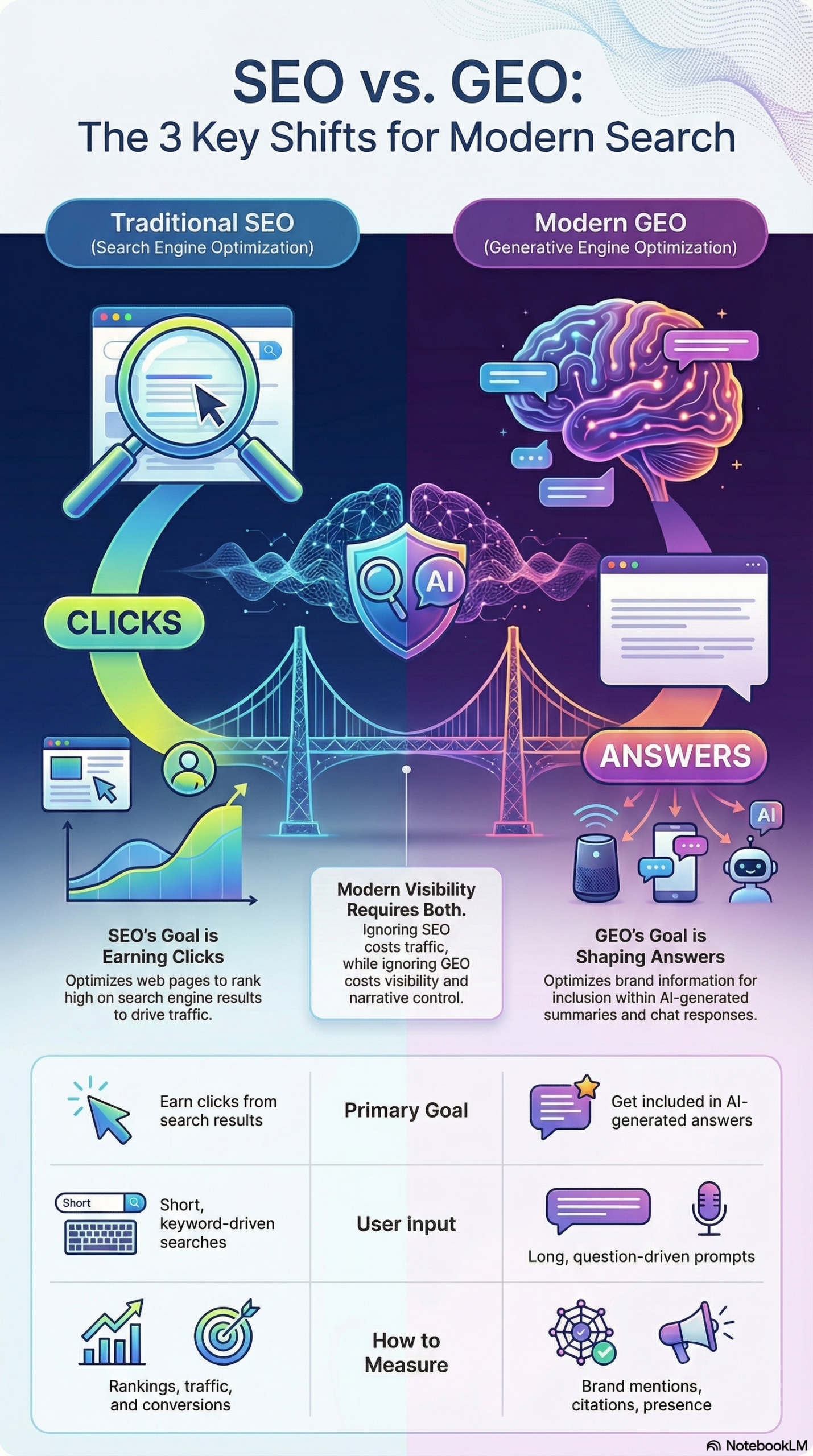
What SEO still does well
SEO performs best when someone seeks options or depth.
- It captures demand when users search with intent and expect to click.
- It gives you control over the experience once visitors land on your site.
- It offers mature measurement through rankings, traffic, and conversions.
- It compounds over time through links, mentions, and authority.
SEO remains critical for high-consideration decisions, local searches, and research-driven behavior. None of that disappears.
What GEO introduces
GEO reflects how AI tools operate.
AI systems do not present ten links. They synthesize information into a single response. They determine which facts matter, which brands appear, and which sources support the answer.
Your content stops being the destination and becomes input.
This introduces several practical shifts.
Fewer clicks
When an AI answer satisfies the question, the user never reaches your site.
Different brand exposure
Your brand might appear in the answer without a click. Or it might disappear from the conversation entirely, even if you rank well in traditional search.
New competition dynamics
You no longer compete page against page. You compete idea against idea. The AI selects pieces of information, not full pages.
The exact traffic impact varies by industry and query type, so broad percentages are unreliable. What remains consistent is the change in how visibility works.
The biggest differences between SEO and GEO
Below is a strategic comparison, not a tactical checklist.
Side by side comparison: SEO vs GEO
| Dimension | SEO | GEO |
| Primary goal | Earn clicks from search results pages | Earn inclusion inside AI generated answers |
| Where visibility happens | Google and Bing results pages | Chat based AI tools and AI summaries within search |
| What you compete on | Page relevance and rankings | Answer inclusion and source selection |
| Unit of optimization | Full pages and site structure | Passages, definitions, lists, and comparisons |
| Typical query style | Short keyword driven searches | Longer question driven prompts with context |
| How authority is signaled | Links, relevance, site quality, technical health | Trust, clarity, consistent brand mentions across credible sources |
| How users engage | Click through to explore options | Read synthesized answers, click less often |
| Measurement focus | Rankings, impressions, clicks, sessions, conversions | Presence in AI answers, citations, brand mentions, downstream impact |
| Primary risk if ignored | Loss of traffic and rankings | Loss of visibility and narrative control |
| Best suited for | Research heavy searches and high consideration decisions | Informational and explanatory questions |
Three takeaways
- SEO focuses on earning clicks.
- GEO focuses on shaping answers.
- Modern visibility depends on both.
Why GEO influences websites without replacing them
Websites are not becoming obsolete. Their role is changing.
Websites serve as evidence.
AI answers often include links or brand references. When users click, they want confirmation or depth. Your site becomes the proof behind the answer.
Websites shape how topics are explained.
AI systems learn from public content over time. Clear explanations, consistent language, and credible positioning influence how subjects are summarized in future answers.
No one can point to a single page and measure its effect on AI behavior. What matters is consistency across public content over time.
Websites see fewer but stronger visits
As some informational clicks disappear, remaining visits often carry higher intent. This increases the value of clarity, trust, and focus on every page.
A simpler way to think about GEO
GEO is not a new channel. It is an additional layer.
- People ask questions.
- AI tools answer those questions.
- Those answers come from existing content.
GEO increases the likelihood that your perspective becomes part of those answers.You no longer optimize only for humans or search engines. You optimize for systems that explain things on your behalf.
Where many marketers misjudge GEO
Most GEO conversations rush straight into tactics, missing the larger risk.
AI tools do not repeat your marketing copy. They synthesize how the web describes you.
If your positioning lacks consistency, AI answers sound generic or inaccurate. If competitors explain the category more clearly than you do, their framing becomes the default.
GEO rewards discipline more than tricks do.
- Clear definitions.
- Consistent language.
- Credible validation beyond your own site.
This blends SEO, brand strategy, and public visibility. Links still matter. Mentions and alignment often matter more than expected.
How smart marketers approach GEO
- They avoid chasing every new AI feature.
- They focus on how their business is described across the web.
- They align messaging across their site, case studies, and third-party mentions.
- They monitor whether AI tools recognize them when relevant questions arise.
- They accept that visibility now includes influence without clicks.
Execution details matter, yet strategy sets the ceiling. Without clarity, optimization stalls.
Why GEO Requires Strategy, Not Quick Fixes
GEO is not a plugin or a checklist. It spans content, structure, authority, and positioning.
Most teams lack the time and distance needed to evaluate how AI systems interpret their presence. They also struggle to align SEO, content, and brand messaging into a coherent approach.
That gap creates an opportunity.
Companies that treat GEO as strategic infrastructure rather than a series of page edits gain a long-term advantage.
Frequently Asked Questions About GEO & SEO
FAQs
What is Generative Engine Optimization (GEO)?
GEO focuses on increasing the likelihood that AI tools include your content or brand in their answers. SEO focuses on rankings and clicks. GEO focuses on influence within AI-generated responses.
Will GEO replace SEO?
No. SEO still drives discovery and traffic. GEO addresses how AI systems summarize and explain information. A strong digital strategy requires both.
Why should non-technical marketers care about GEO now?
AI-driven answers already affect how people research services and ideas. Even without clicks, AI tools shape perception. Ignoring GEO means losing control over how your business is described.
How do I know if GEO matters in my industry?
Ask AI tools the same questions your buyers ask. See which brands appear and how topics are explained. If those answers influence decisions before a click, GEO already plays a role.