
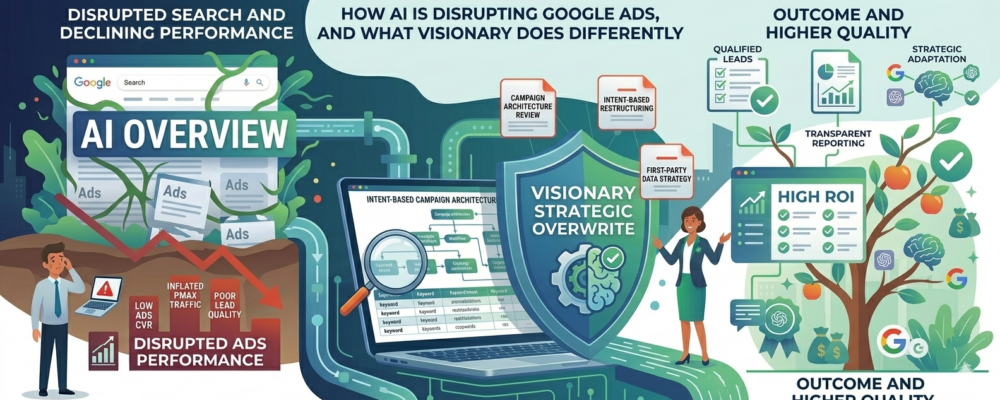
How AI Is Disrupting Google Ads Search Campaigns

Why many businesses are seeing declining performance, higher costs, and weaker lead quality
The implications of AI Disrupting Google Ads extend beyond just clicks; they affect overall marketing strategy.
For years, Google Ads Search campaigns followed a fairly predictable formula. Businesses targeted keywords, wrote ads, optimized landing pages, and competed for clicks.
That model is changing quickly.
This trend of AI Disrupting Google Ads is influencing how marketers strategize their campaigns and allocate budgets.
Artificial intelligence is reshaping how people search, how Google displays information, and how advertising campaigns are managed behind the scenes. As a result, many businesses are seeing declining performance in campaigns that once worked consistently. This shift is often referred to as AI Disrupting Google Ads. The phenomenon of AI Disrupting Google Ads is becoming increasingly evident as businesses adapt to this new landscape.
The difficult part is that the cause is not always obvious inside the reporting.
AI Overviews Are Reducing Ad Visibility
Google’s AI-generated summaries now appear at the top of many search results, particularly for informational and research-oriented searches.
These AI Overviews often answer the user’s question before they ever reach the paid ads or traditional organic listings below. Even when ads still appear, they are frequently pushed lower on the page, reducing visibility and click-through rates.
This is especially affecting businesses targeting broad educational or awareness-stage keywords.
A search like:
“What are executive headshots?”
is now far more likely to trigger AI-generated content than a high-intent search such as:
Understanding the dynamics of AI Disrupting Google Ads is key to reclaiming visibility and engagement.
“Book executive headshots Long Island”
The difference matters.
Businesses relying heavily on informational keyword traffic may experience declining impressions and clicks even when campaign settings remain unchanged.
Buyers Are Starting Their Searches Outside of Google
Search behavior itself is shifting.
Understanding AI Disrupting Google Ads is essential for businesses looking to maintain their competitive edge.
Many consumers now begin research inside platforms like ChatGPT, Perplexity, Claude, Reddit, YouTube, TikTok, and industry-specific communities before ever reaching Google Search.
As AI Disrupting Google Ads continues to evolve, businesses must stay informed about these changes.
The challenge of AI Disrupting Google Ads requires a re-evaluation of existing strategies.
That means some purchase decisions are being influenced, narrowed down, or completed before a Google ad is even displayed.
Traditional search campaigns cannot capture traffic that never enters the Google ecosystem in the first place.
This is creating a growing visibility gap that many advertisers do not yet recognize.
AI-Driven Campaign Automation Can Hide Problems
Google increasingly encourages advertisers to use automated campaign types such as Performance Max, automated bidding, broad match targeting, and AI-generated assets.
While automation can improve efficiency in some situations, it can also make campaigns harder to audit and control.
Many businesses are discovering:
- high traffic with weak engagement,
- increased impressions with declining lead quality,
- budget allocation toward low-value placements,
- inflated reporting metrics that do not translate into sales.
Automation is not inherently bad. The issue is that automated systems optimize around the signals they are given, and those signals are not always aligned with actual business outcomes.
More clicks do not necessarily mean more customers.
Why Surface-Level Optimizations Often Fail
Marketers need to understand the impact of AI Disrupting Google Ads on their current approach to digital marketing.
When campaign performance drops, the first reaction is usually:
- increasing bids,
- rewriting ad copy,
- adding more keywords,
- expanding targeting.
Sometimes those adjustments help temporarily, but they rarely address the larger structural changes happening in search behavior.
The environment itself has changed:
- users are searching differently,
- AI is intercepting informational queries,
- automation is influencing campaign delivery,
- attribution is becoming less reliable,
- visibility is fragmenting across platforms.
Businesses that continue using the same campaign structures from several years ago may find that optimization alone is no longer enough.
What Businesses Should Be Evaluating Instead
Rather than focusing only on traffic volume or click-through rates, businesses should begin asking deeper questions about campaign quality and intent.
Is the campaign targeting buying intent or research intent?
Not all keywords carry the same value.
Informational searches may still generate traffic, but transactional searches often produce stronger conversion potential in today’s AI-driven search environment.
Is automation helping or masking inefficiencies?
With the rise of AI Disrupting Google Ads, traditional methods may no longer suffice.
Campaigns using Performance Max, broad match, or automated bidding should be reviewed carefully to understand where budget is actually being spent.
Are landing pages aligned with user expectations?
Even strong campaigns fail when landing pages are unclear, slow, generic, or disconnected from the user’s search intent.
With AI Disrupting Google Ads, businesses must focus on adapting their strategies to leverage this powerful technology.
As the landscape shifts with AI Disrupting Google Ads, understanding user intent will guide future campaigns.
Is first-party audience data being utilized?
Businesses relying entirely on platform algorithms without building their own remarketing audiences, CRM data, or customer segmentation strategies may become increasingly dependent on systems they cannot fully control.
Are reporting metrics tied to real business outcomes?
Traffic, impressions, and clicks matter, but they are not the final goal.
In conclusion, AI Disrupting Google Ads is a critical aspect that must be addressed in future marketing plans.
Lead quality, phone calls, consultations, purchases, and revenue remain the metrics that matter most.
The Bigger Shift Happening in Search
AI is not simply changing Google Ads.
It is changing how people discover businesses online altogether.
Search is becoming more fragmented, more conversational, and less dependent on traditional keyword behavior. Businesses that adapt early by focusing on intent, quality, transparency, and audience ownership will likely be in a stronger position than those relying entirely on automated advertising systems to make decisions for them.
The changes in user behavior mean that AI Disrupting Google Ads is a central topic for all marketers today.
The integration of AI Disrupting Google Ads into marketing strategies can lead to more effective campaigns.
Frequently Asked Questions
The insights gained from AI Disrupting Google Ads will play a crucial role in shaping future marketing efforts.
Are Google Ads still effective in 2026?
Yes, but campaign strategy matters far more than it did several years ago. High-intent searches still perform well in many industries, particularly when paired with strong landing pages and accurate conversion tracking. The challenge is that AI-driven search features and changing user behavior have reduced the effectiveness of many older campaign structures.
What is Performance Max, and why are some businesses concerned about it?
Performance Max is Google’s AI-driven campaign type that automates targeting, placements, bidding, and creative delivery across Google’s platforms. While it can produce strong results in some cases, many businesses struggle with limited visibility into where budget is spent and whether the traffic being generated is actually producing qualified leads or sales.
How are AI Overviews affecting paid search campaigns?
AI Overviews often appear above traditional ads and organic listings, especially for informational searches. This reduces visibility for some ads and can lower click-through rates on broad educational keywords. Businesses targeting transactional, high-intent searches are generally less affected.
Should businesses reduce their dependence on Google Ads?
For many businesses, diversification is becoming increasingly important. Search traffic now comes from multiple sources, including AI platforms, YouTube, Reddit, social media, email marketing, and first-party remarketing audiences. Relying exclusively on Google Ads may create long-term risk as search behavior continues to evolve.
As you navigate the challenges posed by AI Disrupting Google Ads, staying informed is vital.
As AI Disrupting Google Ads continues to evolve, so too must our strategies in digital advertising.