
The Local 3-Pack Is Dying: How Google’s AI Is Quietly Rewriting Local Search
Posted on Local Search | Google 3-Pack | AI Search | SEO

Part 1 of a two-part series on the future of local search | Digital Horizons by Visionary
AI Rewriting Local Search is transforming the way businesses engage with potential customers. Understanding these changes is key to adapting your strategy.
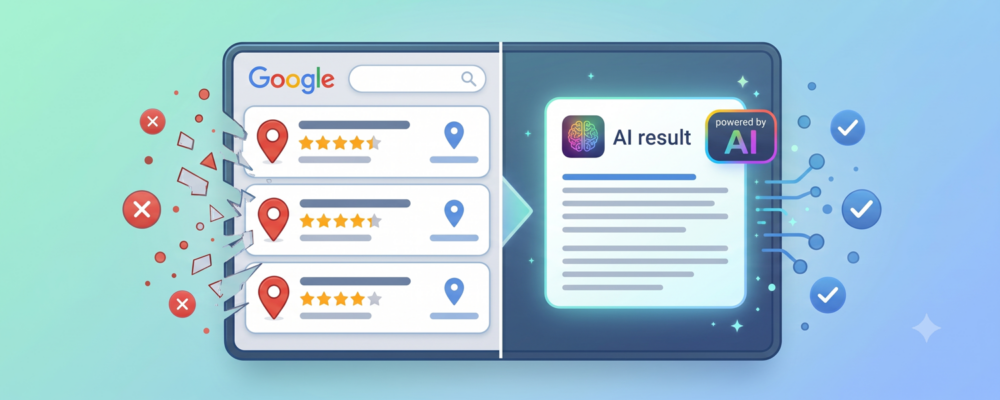
For the better part of a decade, local search had a comforting simplicity. You searched “plumber near me,” and Google returned a little map with three businesses listed beneath it — name, star rating, hours, a website link, and on your phone, a big blue Call button. If you were one of those three, you got found. If you weren’t, you worked to get there. That box has many names: the Local Pack, the Map Pack, the 3-Pack, the “Snack Pack.” Whatever you called it, it was the prize. However, with the emergence of AI Rewriting Local Search, that prize is quietly disappearing, and most business owners have no idea it’s happening. As AI Rewriting Local Search evolves, the traditional methods of getting found are also changing.
That prize is quietly disappearing, and most business owners have no idea it’s happening.
The shift towards AI Rewriting Local Search means businesses must rethink their online strategies to remain competitive.
With the rise of AI Rewriting Local Search, it’s crucial to monitor how these changes affect visibility and engagement.
As AI Rewriting Local Search continues to reshape the landscape, understanding its implications will be imperative for business success.
These AI Overviews are part of the shift towards AI Rewriting Local Search, influencing how consumers interact with search results.
Understanding AI Local Packs is essential in the context of AI Rewriting Local Search, as they change the game for local businesses.
AI Mode represents another facet of AI Rewriting Local Search, creating new opportunities for customer interaction.
Ask Maps, as part of AI Rewriting Local Search, allows users to interact in a more conversational manner with search engines.
The unpredictable nature of results in AI Rewriting Local Search makes it essential for businesses to adapt quickly.
Tracking the impact of AI Rewriting Local Search is increasingly important for understanding audience behavior.
Joy Hawkins’ insights into AI Rewriting Local Search provide valuable data to navigate these changes effectively.
Businesses need to adjust to the new realities of AI Rewriting Local Search to remain competitive.
Understanding how AI Rewriting Local Search affects call functionality is crucial for local business strategies.
The decline in calls highlights the impact of AI Rewriting Local Search on traditional engagement methods.
Monitoring the effect of AI Rewriting Local Search on business performance is essential for maintaining competitiveness.
As competition grows, businesses must leverage the changes brought by AI Rewriting Local Search to ensure visibility.
Given the shifts of AI Rewriting Local Search, businesses must employ new tactics to thrive in this changing landscape.
Adapting to AI Rewriting Local Search is no longer optional; it’s a necessity for local businesses.
The impact of AI Rewriting Local Search on visibility and engagement cannot be underestimated.
As AI Rewriting Local Search continues to evolve, businesses must stay informed and proactive.
The rapid adoption of AI tools underscores the importance of adapting to AI Rewriting Local Search trends.
To succeed in the era of AI Rewriting Local Search, businesses must embrace innovation and change.
Small businesses must recognize the importance of adapting to AI Rewriting Local Search trends to thrive.
The challenges posed by AI Rewriting Local Search can be navigated with the right strategies and insights.
From late 2025 through 2026, Google began replacing the familiar three-listing box with AI-generated results — and the change is doing real damage to small businesses that don’t see it coming. Here’s what’s actually happening, why it matters, and what those who track this most closely are seeing in the data.
Focusing on the changes brought by AI Rewriting Local Search is crucial for maintaining a competitive edge.
As the landscape shifts with AI Rewriting Local Search, businesses must remain agile and responsive.
What’s actually changing on the results page
The short version: Google is layering artificial intelligence on top of (and sometimes in place of) the classic local pack. Depending on what you search for, what device you’re on, and even your search history, you might now see any of several formats.
AI Overviews. The AI-written summaries that now sit at the top of many searches, answering your question before you even scroll to a normal result. For local queries, they sometimes name specific businesses — and sometimes don’t.
AI Local Packs. This is the one causing the most pain. Instead of showing three businesses with phone numbers and call buttons, Google’s AI generates a summary that often features only one or two businesses. It frequently removes the click-to-call button entirely. And it draws from a broader set of sources than before — Yelp, Reddit, Tripadvisor, Instagram — not just Google Business Profiles.
AI Mode. A separate, chat-style tab (powered by Google’s Gemini) where you can ask conversational questions and get a written answer that may recommend businesses. It launched for all US users in May 2025 and reached a billion monthly users within a year.
Ask Maps. Launched in March 2026, it turns Google Maps into a conversational recommender — you can ask it something like “where’s a good quiet café to work from nearby,” and it answers in plain language.
The unsettling part for business owners: two people searching for the exact same phrase from the exact same location can now see completely different results. The single, predictable 3-Pack has become a moving target.
The data: what Joy Hawkins and Sterling Sky are seeing
If you want to understand this shift, the person to follow is Joy Hawkins of the local SEO agency Sterling Sky. She’s a longtime Google Business Profile Product Expert and has been documenting these “AI Local Packs” with screenshots and hard data since late 2025. Her findings are the most-cited primary research on the topic and are sobering.
Fewer businesses are surfaced. When Sterling Sky’s ranking data was analyzed, the new AI Local Packs featured 5,943 unique businesses, compared with 18,330 in traditional 3-Packs across the same searches. In plain terms: the AI format surfaces only about 32% as many businesses. Across 322 local markets studied, 88% showed fewer unique businesses in the AI results than in the old local pack. Fewer spots, more competition for each one.
The call buttons are disappearing. AI Local Packs often omit the click-to-call button that drove so many phone calls to local businesses. For some industries, Google even replaced call buttons with images.
Calls are dropping — even when your rankings look fine. This is the sneakiest part. Sterling Sky partnered with the analytics firm Jepto to study call data from 179 Google Business Profiles across 34 US law firms over two years. The findings: clicks-to-call have been steadily declining; the drop is concentrated on mobile (where those call buttons used to live); and — crucially — most rank-tracking software can’t even see AI Local Packs yet. So your monthly SEO report says you’re still in the top three, everything looks healthy on paper, and meanwhile your phone rings less and less.
As Barry Schwartz of Search Engine Roundtable summarized in January 2026, some businesses are seeing declines of 50% or more tied to this local pack change.
Ads are filling the gap. In 2025, the share of Sterling Sky’s mobile reports showing local pack ads jumped from roughly 1% to about 22%, and Local Services Ads climbed from around 11% to 31%. As free organic spots shrink, paid ones expand. Google is increasingly pay-to-play.
Why this matters more than it sounds
It’s tempting to file this under “SEO changes again, as it always does.” But the math here is genuinely different.
When three businesses are visible, being in the top three means being seen. When the AI shows one recommendation, being ranked #2 or #3 can mean being invisible. This is a shift toward winner-take-most — and in many markets, winner-take-all. The gap between the business that gets named and everyone else grows dramatically.
At the same time, these AI answers are designed to keep people from clicking through at all. When Google’s AI just tells the searcher the answer — including which business to call — there’s often no reason to visit any website or profile. That’s the “zero-click” problem, and it’s accelerating. One analysis found that when an AI Overview is present, the top organic result’s click-through rate can drop by more than half.
Customers are embracing it quickly. According to BrightLocal’s 2026 consumer survey, the share of people using AI tools to find local businesses jumped from 6% to 45% in a single year — now the third most popular way to discover local businesses, behind only Google Search and Facebook. Over the same period, Google’s overall share of local discovery slipped from 83% to 71%. Google remains the giant in the room, but the room is changing shape quickly.
The takeaway
The old game — “get into the 3-Pack and collect the calls” — is being replaced by a new one in which AI often picks a single winner, hides the call button, and answers the customer without routing them anywhere. If you’re a small business relying on that steady drip of Google phone calls, this trend will quietly reshape your pipeline over the next year, whether or not you’re paying attention.
The good news: this isn’t hopeless, and the businesses named by the AI aren’t chosen at random. There are concrete, controllable factors that make you the one Google’s AI recommends — and that’s exactly what we’ll cover in Part 2: Winning the One Spot.
Frequently Asked Questions About Google 3-Pack
Is the traditional Google Local 3-Pack gone completely?
No — not yet, and not everywhere. As of 2026, the AI Local Pack that replaces the 3-Pack appears mostly on mobile devices in the US and on a minority of searches (Sterling Sky tracked it on roughly 7–8% of keywords, “and rising”). For many searches, you’ll still see the classic three-listing box. The point isn’t that the 3-Pack vanished overnight; it’s steadily being displaced, and the trend is moving in one direction. This is the moment to prepare, not panic.
Why do my rankings look fine but my phone is ringing less?
Because most rank-tracking tools still can’t detect AI Local Packs, your report checks whether you appear in the traditional local pack — and you might still “rank” there — while the AI version shown to real mobile users features a different business, removes the call button, or answers the question without anyone needing to call. Your ranking report measures a version of the results page that fewer and fewer people actually see. This is why tracking actual calls and conversions matters more now than tracking rank positions.
Is ChatGPT the reason I’m losing local traffic?
For most local businesses, not really — the bigger factor is Google’s own AI. Sterling Sky’s client data shows that standalone assistants like ChatGPT still drive only a tiny share of traffic compared to Google. The declines they’re documenting stem from changes happening right inside Google’s search results: AI Overviews answering questions without a click and AI Local Packs replacing the 3-Pack. Since Google still drives the majority of local discovery, that’s where your attention should go first.
Where is Google pulling its AI recommendations from?
It uses a wider net than the old 3-Pack did. The classic local pack drew almost entirely from Google Business Profiles. The new AI results also pull from third-party sources — Yelp, Reddit, Tripadvisor, Instagram, industry directories, and business websites — and stitch them together to decide who to recommend. That’s useful to know, because it means your reputation and presence across the web, not just on your Google profile, now feed directly into whether the AI names you.