
How AI Is Quietly Rewriting Single Scan Tracking and Why Your Analytics Dashboard Is Lying to You
Posted on Zero-Click Search | AI Search | Local Search | Single Scan Tracking

- Single scan tracking is the old, reliable way marketers measured discovery: a person searched, clicked, landed on your page, and every step left a trackable footprint you could follow scan by scan.
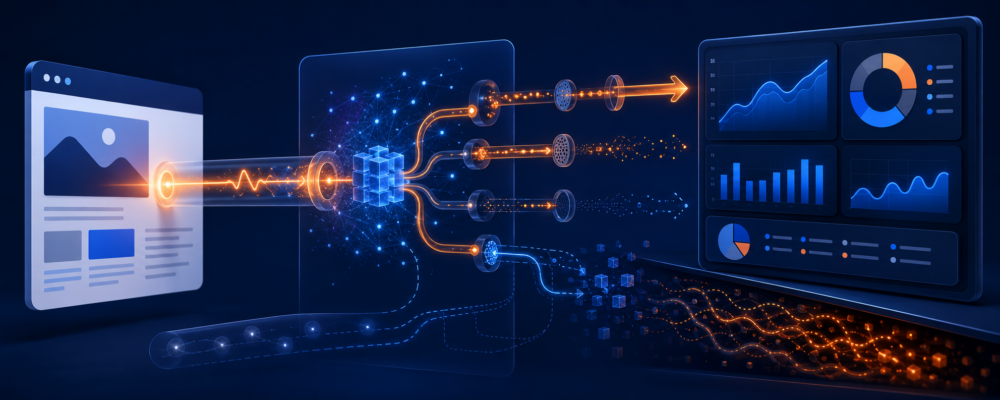
- AI search is collapsing that journey into one invisible pass. Answer engines like Google’s AI Mode, ChatGPT, and Perplexity read your content once and hand the user a finished answer — no click, no session, no trail.
- The numbers are already stark. Roughly 69% of Google searches now end without a click, up from 56% before AI Overviews launched. When an AI summary appears, click rates roughly halve.
- Your analytics are misreporting reality. Because most AI platforms strip referrer data, a large share of AI-driven visits get filed as “direct” — so your dashboard undercounts exactly the channel that’s growing fastest.
- The fix isn’t a new tracking pixel. It’s a new measurement model — one built on citation presence, branded search lift, and AI-aware channel grouping. This is ongoing work, not a one-time setup.
Here’s an uncomfortable question for anyone who reports on marketing performance: what percentage of the people who discovered your business through search this month actually show up in your analytics?
Five years ago, the honest answer was “almost all of them.” Someone typed a query, saw a list of links, clicked yours, and landed on a page you controlled and measured. You could watch the whole thing happen — one trackable scan at a time.
Today, that answer is shrinking fast, and most marketing managers don’t realize it yet. The reason has a name that’s starting to circulate in SEO circles: the erosion of single scan tracking. Understanding what that phrase means, and what AI is doing to it, is quickly becoming the difference between a marketing report that reflects reality and one that quietly misleads your leadership team every single month.
So What Is Single Scan Tracking?
Single-scan tracking is the traditional model for measuring discovery, in which each individual interaction with your content is captured and counted separately.
Think of a “scan” as a single measurable touchpoint: a page view, a click, a session, or an event. In the classic search-to-conversion journey, there were many such touches, each leaving data behind. A prospect searched for “industrial gearbox supplier,” clicked your result, viewed your product page, downloaded a spec sheet, returned a week later, and filled out a contact form. Every scan along that path was visible in Google Analytics. You could see the entry point, the referral source, the path through your site, and the conversion. You could confidently attribute the lead to organic search.
That completeness made SEO measurable and therefore fundable. When a marketing manager could stand in front of the CFO and say, “organic search drove 40% of our qualified leads at $31 each versus $181 for paid,” the budget conversation was easy. Single-scan tracking made that sentence possible.
The catch is that this entire model rests on one assumption: that people leave the search engine to visit your website. AI is dismantling that assumption.
The Shift Most Businesses Haven’t Noticed Yet
Here’s where it gets interesting, and where most agencies are still selling you a 2019 version of reality.
AI answer engines don’t send people on a journey. They compress it. When someone asks ChatGPT, Google’s AI Mode, Gemini, or Perplexity a question, the AI has already done the “scanning” for them: it read your content (and your competitors’) earlier, absorbed it, and now generates a single synthesized answer on the spot. The user reads that answer and, very often, never clicks anything at all.
In other words, the many trackable scans that used to make up a discovery journey have collapsed into a single scan the AI performs on your behalf, one you can’t see, can’t count, and can’t include in a report.
This isn’t a fringe scenario. According to SimilarWeb data, roughly 69% of Google searches now end without a click, up from about 56% before AI Overviews launched in mid-2024. A Pew Research study of nearly 68,000 real search sessions found that when Google shows an AI summary, users click a traditional result only about 8% of the time, compared with 15% when no summary appears. That’s nearly a 50% reduction in the clicks your analytics depend on. Bain & Company estimates that AI-driven zero-click behavior is reducing organic traffic by 15% to 25% for many sites.
The business your content is winning hasn’t disappeared. The evidence of winning it has.
Why Your Analytics Dashboard Is Actively Misleading You
This is the part that should concern any marketing manager who reports numbers upward.
It would be one thing if AI-driven discovery simply appeared in your reports as a smaller, but honest, channel. The real problem is that it often shows up in disguise. Most AI platforms suppress the referrer information that analytics tools rely on to identify where a visitor came from. When someone clicks through from an AI answer, or copies your URL from one and pastes it into their browser, that referrer data frequently vanishes.
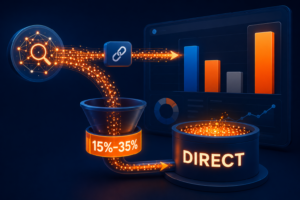
The result: analysts estimate that 15% to 35% of AI-driven traffic is misclassified as “direct” in tools like GA4. Google’s own AI Overviews are nearly indistinguishable from ordinary organic traffic. As a result, the fastest-growing source of new business is being quietly folded into buckets labeled “direct” and “organic,” where it’s invisible as a trend.
Now layer on a second gap. Industry surveys suggest that about 89% of brands already appear in AI-generated search results, yet only about 14% of marketers actively track their AI citation visibility. Nearly nine in ten businesses are described, recommended, or omitted in AI answers every day, and almost none of them are measuring it. If your competitor is the one ChatGPT names when a prospect asks, “Who are the best professional services firms for X?” you may never see that loss in a single line of your analytics.
For a manufacturer, a professional services firm, a non-profit, or a growing tech company, this creates a dangerous illusion. Your dashboard can look stable, even healthy, while the way customers actually find you shifts beneath the surface. Flat “organic” numbers can mask a real decline in trackable clicks, which is being obscured by misclassified AI traffic. You can be winning and losing at the same time, and your current reports won’t tell you which.
What This Looks Like for a Real Business
Let’s make it concrete. Say you run marketing for a mid-sized commercial HVAC manufacturer. For years, your top-performing content was a detailed guide comparing rooftop unit efficiency ratings. It ranked well, drove steady organic traffic, and consistently generated spec-sheet downloads you could trace to search.
This year, something odd happens. Your download numbers soften, but your “direct traffic” ticks up. Branded searches for your company name are climbing in Search Console. Sales reports that more inbound prospects are arriving already familiar with your product line: “I saw you were recommended when I asked about high-efficiency rooftop units.”
Nothing in your old single-scan reports explains this cleanly. But the real story is straightforward. AI answer engines are reading your efficiency guide, using it to answer buyers’ questions directly, and naming your company as a credible option. Prospects are getting pre-qualified inside the AI conversation, then coming to you directly. The discovery happened; it just happened in a single AI scan you couldn’t track, and the payoff is landing in the wrong column of your spreadsheet.
The same pattern plays out across every vertical, just with different tells. A professional services firm sees fewer contact-form fills from organic search but more prospects who arrive already able to name the firm’s specialties because an AI walked them through the shortlist first. A non-profit notices donation-page traffic labeled “direct” climbing after a season of strong content, as AI assistants answer “which organizations work on X” by naming it. In each case, the discovery and the demand are real; the single, trackable scan that used to document them is what’s gone.
That’s not a reason to panic. It’s a reason to change what you measure. And there’s a genuine upside to the shift: because AI engines effectively pre-screen and recommend you before anyone arrives, the visitors who do come through are typically further along and more likely to convert. The traffic gets smaller and warmer at the same time.
What Replaces Single Scan Tracking
You can’t put the old model back together, and chasing a magic pixel that “tracks AI” is a fool’s errand. What works is a layered measurement approach that accepts the single scan is invisible and triangulates around it instead.
Start by tracking citation presence, you have your new leading indicator. Once a month, run a set of 20 to 50 of the commercial questions your best customers actually ask (“best [your category] for [use case],” “how to choose a [your product],” “[your company] vs [competitor]”) through ChatGPT, Gemini, Perplexity, and Google’s AI Mode. Record whether you’re mentioned, how you’re described, and who’s cited alongside you. That “share of citation” is the closest thing AI search has to a ranking, and it moves before your traffic does.
Then watch branded search and direct traffic together. When AI engines recommend you more often, people search for your name and type your URL directly. A rising trend in Search Console for branded queries, tracked alongside your citation presence, is strong evidence that AI discovery is working, even when individual scans remain invisible.
Finally, teach your analytics to recognize AI. Build a custom channel grouping in GA4 that filters referrals from domains like chatgpt.com, perplexity.ai, gemini.google.com, and claude.ai, and tag any links you control with a UTM parameter such as utm_medium=ai_search. Add a simple “How did you hear about us?” field to your contact and lead forms, including “AI assistant / ChatGPT” as an option. That self-reported data captures dark-funnel discovery your pixels miss and is often the single most honest number you’ll get.
None of this is a one-time configuration. AI platforms change how they cite, which referrers they pass, and how they surface answers on an ongoing basis. Measuring AI discovery is a monthly discipline, just like modern SEO: you review citation presence, adjust content, and re-check the signals. The picture gets sharper each cycle.
The Content Side: Get Read Once, Get Read Right
Here’s the strategic pivot behind all of this. If AI is going to read your content just once and use that scan to represent you in thousands of conversations, then being readable and quotable in one pass becomes a core marketing objective, not a technical afterthought.
That means content built for extraction: clear, self-contained answers near the top of the page; specific, verifiable facts and statistics that AI models prefer to cite; named sources; clean heading structure; and schema markup that tells machines exactly what your page is about. Content optimized this way has been shown to achieve meaningfully higher AI visibility than generic pages. A well-architected WordPress site makes this far easier to execute because the heading hierarchy, internal linking, and structured data that help AI understand you are the same fundamentals that helped your site rank in the first place. Strong AI Search Optimization doesn’t replace good SEO; it’s built on top of it.
The businesses that will thrive aren’t the ones clinging to the tracking model that’s fading. They’re the ones who accept that discovery now often happens in a single, invisible AI scan and who build both their content and their measurement around that new reality. The click was never the point. Being chosen was. AI has just made the choosing happen somewhere you can’t watch — which makes measuring the signals of being chosen the most valuable skill in marketing right now.
Frequently Asked Questions About Single Scan Tracking
What exactly is “single scan tracking,” and why is it suddenly a problem?
Single-scan tracking is the traditional way marketers measured discovery: each interaction (a click, a page view, a session) was captured and counted individually, allowing you to follow a prospect’s path from search to conversion, one trackable step at a time. It became a problem because AI answer engines collapse that multi-step journey into a single pass. The AI reads your content once, generates a direct answer, and the user often never clicks through to your site. Discovery still happens, but the trackable “scans” that used to prove it disappear. That’s why reports that looked complete two years ago now have a growing blind spot.
Does this mean my Google Analytics data is wrong?
Not wrong, exactly, but increasingly incomplete and misleading if taken at face value. Most AI platforms strip the referrer data that analytics tools use to identify a visitor’s source, so an estimated 15% to 35% of AI-driven traffic gets misclassified as “direct.” Google’s AI Overviews traffic is nearly impossible to separate from ordinary organic traffic. The practical implication is that flat or “stable” organic numbers can mask a real shift in how customers find you. Your analytics still matter enormously; you just have to layer AI-aware measurement on top and stop treating the dashboard as the whole truth.
If AI is reducing clicks, is SEO still worth the investment?
More than ever, the goal has widened. AI engines don’t invent answers; they assemble them from content they’ve read and trust. If your pages aren’t well-optimized, clearly structured, and genuinely authoritative, you won’t be the source AI pulls from or cites. So the same fundamentals that drove traditional rankings (quality content, technical soundness, semantic depth, verifiable facts) now also determine whether you appear in AI answers at all. The return isn’t just clicks anymore; it’s being the business an AI recommends before a prospect ever reaches your site. Businesses that abandon SEO right now are essentially opting out of the channel that’s replacing the one they’re worried about.
How do I actually measure whether AI search is working for my business?
Use a three-layer approach rather than hunting for one perfect metric. First, track citation presence: each month, run 20 to 50 of your customers’ real buying questions through ChatGPT, Gemini, Perplexity, and Google’s AI Mode, and record whether and how you’re mentioned. Second, watch branded search and direct traffic in Google Search Console and GA4: when AI recommends you more, people search your name and visit directly, so those lines rising together is strong confirming evidence. Third, build an AI channel group in GA4 (filtering for chatgpt.com, perplexity.ai, gemini.google.com, and similar) and add an “AI assistant / ChatGPT” option to your lead forms to capture what your pixels miss. Reviewed monthly, those three signals give you a reliable read on AI discovery, even though the underlying scan stays invisible.
Wondering what AI is already saying about your business?
Most companies have never actually checked how they show up when a customer asks an AI assistant for a recommendation, and the answer is often surprising. We audit your AI search visibility, rebuild your content to be read and cited in a single pass, and set up measurement that finally shows you the discovery your old reports were missing.
Get a free AI Search Visibility Audit. We’ll show you exactly where you appear and where a competitor is taking your place.
We are custom WordPress developers specializing in AI Search Optimization, SEO, ADA Compliance, and Digital Marketing. Our monthly programs are built for the way people actually find businesses now, because the search landscape doesn’t hold still, and neither should your strategy.