

5 Surprising Truths About Google’s New AI Search and the Future of the Web
Posted on Zero-Click Search | AI Search

The 30-year-old pact that built the modern internet is broken, and Google is holding the hammer. If you use its search engine, you’ve seen the first cracks appear: AI-generated summaries called “AI Overviews” now sit at the top of many results. But this is just a tremor before the earthquake. Google’s new, optional “AI Mode” is a “total reimagining of Search” that replaces the traditional list of blue links altogether. This isn’t just an update; it’s a declaration that the fundamental bargain of the web—websites provide content, Google provides traffic—is over.
Critics call it an apocalypse in the making, one that could hollow out the open web and cost millions of jobs. Google, meanwhile, insists this is a necessary evolution that will make the internet healthier and more useful. This high-stakes debate isn’t about technology; it’s about control over the future of information itself. Our investigation reveals the five most important truths you need to understand about this new era of search and the battle for the soul of the internet.
1. The 30-Year-Old Bargain Between Google and Websites Is Over
For decades, the web ran on a simple, unwritten rule: websites create free content, and Google sends them traffic in return, which is how most sites make money. This symbiotic relationship fueled the vibrant, independent “open web” we know. That system is now crumbling. AI Overviews and the far more radical AI Mode are designed to give users answers directly on the search page, eliminating the need to click through to the source.
As Gisele Navarro, managing editor of the review site HouseFresh, puts it:
It’s like asking a librarian for book, but they just tell you about the book instead.
This shift has publishers accusing Google of outright theft. “This is the definition of theft,” says Danielle Coffey, president of the News/Media Alliance. “They’re making money on our content and we get nothing in return.” The power imbalance is stark, especially as US courts have recently found Google operates not one but two illegal monopolies in search and digital advertising. For critics, this isn’t a minor tweak. SEO strategist Lily Ray warns of a “devastating impact on the internet,” while Navarro predicts it could “destroy the open web as we know it.”
2. You’re Becoming More Visible, But Getting Fewer Clicks
Our analysis reveals a central paradox of the AI search era: your content is being seen more often but clicked on far less. Data from analysis firm BrightEdge shows a startling trend since AI Overviews were introduced: website impressions have soared by 49%, while actual clicks have plummeted by 30%.
This is happening because Google scrapes content from websites to generate its AI answers, giving those sites a citation within the overview. But because the AI provides the summary, users have no reason to click the source link. This is accelerating the rise of “zero-click” searches, with some analyses finding that 60% of Google searches now end without a single visit to a website. Google disputes this narrative, claiming its AI features send “higher quality” traffic to a “greater diversity of websites,” but has not provided data to back up these claims. For the millions of publishers who depend on that traffic, the trend is an existential threat. As Lily Ray states:
If Google makes AI Mode the default in its current form, it’s going to have a devastating impact on the internet.
3. Your New Primary Audience… Is a Robot
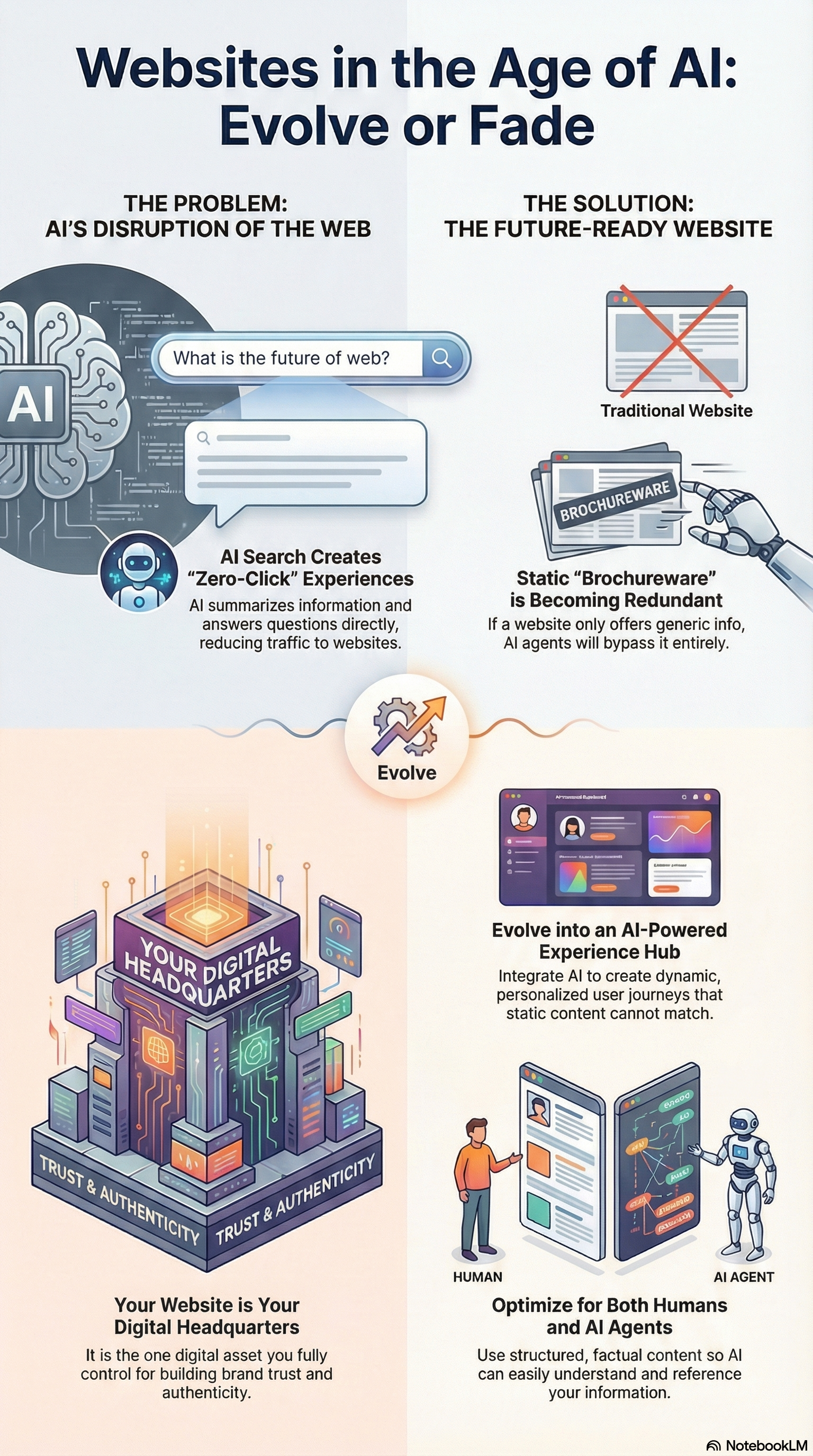
This collapse in human clicks creates a new, bizarre reality for content creators: welcome to the “machine web,” a future where your primary audience is a robot. For Google’s AI to generate answers, it must first consume vast amounts of high-quality, human-written content. In this new paradigm, the AI becomes the main “reader” of your website.
This shift presents a catastrophic economic problem, which Matthew Prince, CEO of web infrastructure company Cloudflare, states bluntly:
Robots don’t click on ads.
If AI is the main consumer of content, the ad-based business model that sustains much of the web collapses. While a few massive publishers like Reddit or The New York Times are striking multi-million dollar licensing deals for their data, this is not a scalable solution. As advertising technology executive Tom Critchlow notes, “It’s difficult to see how that would work as a replacement for the decline in clicks” for the millions of smaller, independent sites that form the backbone of the open web.
4. Your Website Isn’t Obsolete—It’s Your ‘Authoritative Source’
It seems counter-intuitive, but in an age of AI-generated answers, your website is more critical than ever. Its role, however, is changing dramatically. A website is no longer just an “Information Dispenser” for human visitors; it is evolving into a “Brand Anchor” and “Conversion Engine”—the single source of truth that both feeds the AI and captures your most valuable users.
In this new era, your website must serve four essential functions:
- The Content Source: Act as the single, authoritative source of truth that feeds the AI. If your unique, in-depth content doesn’t exist, the AI can’t cite you.
- The Hub of Conversion: Handle the actions an AI cannot, like processing payments, generating leads, or signing users up for a newsletter. Your website is the non-negotiable platform for these critical business functions.
- The High-Quality Click Destination: Capture highly motivated, conversion-ready visitors who click through afteran AI summary because they need more depth or want to make a purchase.
- The Trust Builder: Serve as the platform for demonstrating Experience, Expertise, Authoritativeness, and Trustworthiness (E-E-A-T) signals that both AI algorithms and humans rely on to determine credibility.
5. Success Is No Longer Measured in Clicks
Given that the old bargain is broken and robots don’t click ads, how can a business possibly measure success? The answer lies in shifting focus from clicks to influence. Since traditional metrics like organic traffic and click-through rate (CTR) are losing their meaning, businesses must adopt a new scorecard for a zero-click world.
Here are the new metrics that matter:
- SERP Impressions: This is now a primary indicator of visibility. Tracking how often your brand appears in search results, even without a click, shows you are part of the AI-driven conversation.
- AI Mentions & Citations: This is the new “ranking.” Measuring how often your brand is mentioned or cited as a source within an AI Overview is a direct proxy for authority.
- Branded Search Volume: An increase in users searching directly for your brand name is a powerful signal that non-click exposure in AI answers is successfully building brand awareness.
- Direct Traffic: A lift in visitors who type your URL directly is another key indicator that your brand is gaining recognition from its visibility on the search results page.
Conclusion: The Dawn of the Machine Web
We are witnessing a profound transition from an open web built on clicks to a “machine web” built on answers. Google justifies the disruption by pointing to user behavior, claiming, “As people use AI Overviews, we see they are happier with their results, and they search more often.”
While Google heralds an age of convenience, it’s impossible to ignore the cost: a potential hollowing-out of the vibrant, chaotic, and independent web that has defined the digital age. This isn’t just an algorithm update; it’s a battle for the soul of the internet. To survive, websites must become more authoritative and conversion-focused than ever. But as we step into this new future, we must ask a critical question: As we increasingly rely on AI to synthesize the world’s information for us, what do we gain in convenience, and what essential parts of discovery and diversity do we risk losing forever?