
Query Expansion for SEO: The Missing Link Between Your Content and Higher Rankings
Posted on SEO | Query Expansion | Semantic Search | Topic Clusters

Google doesn’t rank pages just by matching exact keywords, it expands queries behind the scenes to interpret meaning, so content needs depth and breadth, not exact phrase repetition.
Traditional keyword-centric SEO often fails because it ignores related questions, synonyms, and topic coverage that search systems actually look for.
To align with query expansion, teams should shift to topic-based content clusters, answer real user questions, and structure content clearly (headings, FAQs, schema).
Strong, comprehensive topic authority helps pages rank for many variations, break through traffic plateaus, and even get referenced in AI-generated search summaries.
Most marketing teams don’t wake up thinking about semantic search models.
They wake up thinking:
Why aren’t we showing up for this?
Why is traffic flat?
Why are competitors outranking us with content that doesn’t even seem better?
Here’s what’s usually happening.
You’re optimizing for specific keywords.
Google is optimizing for meaning.
That gap is where visibility gets lost.
Query expansion for SEO is the system Google uses to interpret what users mean, not just what they type. And if your SEO strategy doesn’t align with that reality, you’re unintentionally limiting your reach.
This isn’t technical theory. It directly affects how often your website appears, how much qualified traffic you attract, and whether you show up in AI-generated search summaries.
Let’s simplify it.
What Is Query Expansion, in Plain English?
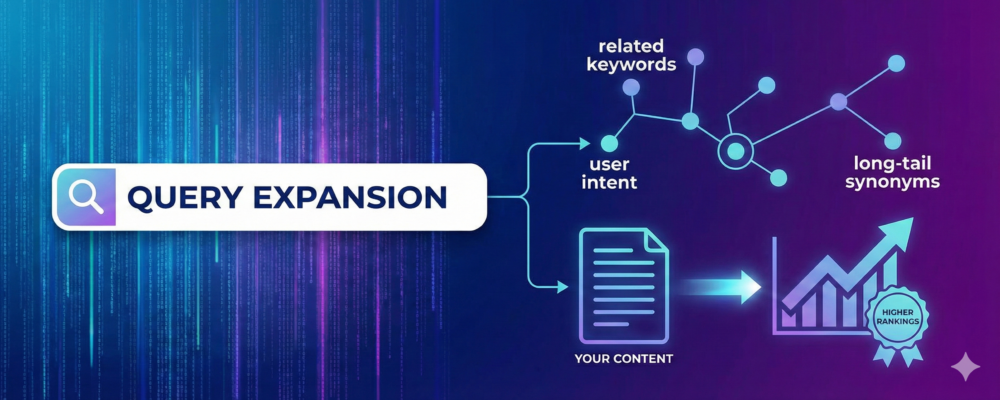
Query expansion is how Google broadens a user’s search behind the scenes.
When someone types a short, vague, or incomplete phrase, Google doesn’t treat it literally. It expands that query by adding synonyms, related concepts, contextual intent, and implied questions.
Understanding Query Expansion for SEO can significantly enhance your content strategy and improve your search rankings.
For example, if someone searches for a service category, Google evaluates what people typically mean when they search that category. It connects related problems, terminology variations, and supporting topics.
This process is powered by machine learning systems like Google BERT and Google MUM, which analyze language context rather than matching exact words.
The takeaway is simple.
Google doesn’t need your page to repeat a keyword.
It needs your page to fully address a topic.
If it does, you rank for far more than the one phrase you targeted.
If it doesn’t, you rank for almost nothing beyond it.
The Real Problems Query Expansion Solves
Let’s frame this around the frustrations most organizations deal with.
Problem 1: “We Optimized the Page, But It Still Isn’t Ranking”
This is the most common complaint.
The page includes the target keyword.
The title tag is optimized.
The headers look correct.
And yet, competitors outrank you.
Why?
Because Google isn’t evaluating whether your page includes a phrase. It’s evaluating whether your page demonstrates topical depth.
If a competitor’s page addresses the broader universe of related questions, subtopics, and intent signals, Google considers that page more authoritative.
Query expansion rewards breadth and clarity, not repetition.
The solution isn’t adding the keyword five more times.
It’s expanding the scope of the content to cover the full topic ecosystem.
Problem 2: “We’re Competing With Brands We Can’t Beat”
Large companies dominate broad search terms.
Trying to rank for generic category keywords often means competing against national brands with massive authority.
Query expansion shifts the battlefield.
Instead of chasing the most obvious terms, you build structured content around specific use cases, supporting questions, subtopics, and problem-driven searches.
When Google expands user queries into related variations, your content becomes eligible for those searches.
This is how mid-sized organizations gain visibility without outspending competitors.
You’re not trying to win the loudest term. You’re building authority across the topic.
Problem 3: “Traffic Is Plateauing”
You may think you’ve covered your keywords.
But no team can manually target every variation people search.
There are endless synonym variations, question-based searches, intent modifiers, and conversational phrases.
If your content is narrow and phrase-driven, you hit a ceiling quickly.
Query expansion allows a single, well-structured page to rank for hundreds of related searches.
But only if the page covers the topic comprehensively.
When you move from keyword pages to topic authority, you expand your total search footprint.
That’s how plateaus break.
Problem 4: “AI Overviews Are Stealing Our Clicks”
Search is changing.
Google now provides AI-generated summaries directly on results pages. That means users often receive answers without clicking.
If your content is shallow or narrowly optimized, it’s unlikely to be cited in those summaries.
AI systems pull from content that clearly answers questions, defines terms precisely, is well structured, and demonstrates authority.
Query expansion plays a role here because AI systems evaluate how well your content addresses the expanded meaning of a query.
When your content reflects topical authority, you increase your eligibility to be referenced in AI summaries.
This isn’t about gaming AI.
It’s about being the clearest resource in your category.
What Marketing Teams Need to Do Differently
You don’t need more keywords.
You need better structure.
Here’s the practical shift.
1. Stop Thinking in Isolated Keywords
Traditional SEO starts with a list of phrases.
Modern SEO starts with a topic.
Instead of asking, “What keywords should we target?” ask, “What is the full universe of questions, concerns, and subtopics around this service?”
When you map the entire topic ecosystem, your content naturally aligns with expanded queries.
This makes your pages more resilient and more visible.
2. Build Topic Clusters
The most effective way to operationalize query expansion is through a structured content model.
The core page is a comprehensive overview of a main topic. It addresses the broad subject in an organized, authoritative way.
Supporting pages go deeper into individual subtopics or questions. Each supporting page links back to the main topic page, and the main page links outward to the supporting content.
This internal structure tells Google you aren’t just mentioning a topic. You own it.
When queries are expanded to include related angles, your content network supports that interpretation.
3. Write for Questions, Not Just Terms
Google’s systems are trained on natural language.
If your content reads like it was written for a search engine instead of a person, it’s at a disadvantage.
Effective pages start with a clear answer to the core question, use logical headings, include FAQ sections, and provide concise summaries before expanding.
This structure makes it easier for search engines to interpret your authority.
Clarity is not optional anymore.
4. Use Structured Data (Schema)
Schema markup is structured code that clarifies what your content represents.
It tells Google whether a page is an article, a service, an FAQ, a product, or a local business.
Schema acts as a translator between your content and search systems.
When aligned with strong content, it strengthens your visibility in rich results and AI-driven features.
It doesn’t replace strategy. It reinforces it.
Tools That Support This Approach
You don’t need every SEO platform on the market. But you do need insight into how topics cluster.
For question discovery:
AnswerSocrates
AlsoAsked
For competitive topic coverage:
SEMrush
Ahrefs
For topic clustering and entity optimization:
InLinks
These tools help you see how Google connects related ideas.
But remember, the strategy matters more than the platform.
What This Means for Your Organization
Here’s the shift in mindset.
Old SEO question:
“Are we optimized for this keyword?”
New SEO question:
“Have we fully addressed this topic in a way that demonstrates authority?”
Query expansion rewards the second approach.
This has implications for content planning, editorial calendars, internal linking strategy, and AI search visibility.
It also changes how you measure success.
Instead of tracking single keywords, you monitor topic-level performance and total search visibility.
That’s a more stable long-term growth model.
The Bottom Line
Query expansion is not a technical trick.
It’s the reason Google understands your customers better than they understand themselves.
If your content strategy is narrow, you appear narrow.
If your content strategy is comprehensive, Google expands your visibility.
You don’t need to predict every search.
You need to build the most complete, clearly structured resource in your niche.
When you do that, Google’s systems connect you to the right searches.
That’s how modern SEO solves real marketing problems.
Frequently Asked Questions
Is query expansion something we can directly control?
No. Query expansion happens within Google’s systems. You cannot manipulate it directly. What you can control is how comprehensively your content addresses related questions, synonyms, and subtopics. Strong topical authority aligns naturally with expanded queries.
Does query expansion replace traditional keyword research?
It evolves it. Keyword research still identifies demand and intent. But instead of targeting phrases in isolation, you group them into topic clusters. That shift produces broader visibility and more sustainable rankings.
How does query expansion affect AI-generated search results?
AI systems evaluate whether content clearly answers expanded user intent. Pages that are structured, authoritative, and question-driven are more likely to be cited in AI summaries. Thin keyword pages rarely qualify.
How long does it take to see an impact?
When implemented through structured content clusters and internal linking, organizations often see measurable improvements within three to six months. The results compound over time because topical authority builds trust with search engines.